Once the British had defeated Napoleon in Europe, they had little reason for continuing to seize American ships and cargo. Why not make peace with the United States? In August of 1814, treaty negotiations between the United States and Britain began in the neutral town of Ghent, Belgium. The United States sent John Quincy Adams (the son of President John Adams), Henry Clay, Albert Gallatin, James Bayard, and Jonathan Russell to negotiate with the British.
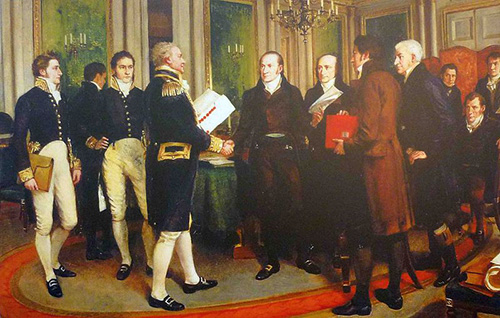 |
| The Signing of the Treaty of Ghent, Christmas Eve, 1814, Amédée Forestier. |
Work on the Treaty of Ghent was completed by the end of December. The peace commissioners signed the treaty on December 24, 1814. Read the excerpts from the Treaty of Ghent below to gain a better understanding of its terms.
How directly did the Treaty of Ghent address the issue of American neutral shipping rights?
Based on the terms of the Treaty of Ghent, who won the War of 1812?
| Your Responses | Sample Answers |
|---|---|
| Not at all directly. British interference with American trade was the main reason President Madison asked for a declaration of war against Britain. And yet the treaty does not mention shipping rights at all. | |
| Neither side won the War of 1812. Each Article of the treaty requires anything seized during the war to be returned. Article One requires all land to be returned to either side. Article Three requires all prisoners captured to be returned to either side. And Article Nine requires the United States to return any lands taken from Native Americans to be returned. | |
Treaty of Peace and Amity between His Britannic Majesty and the United States of America.
ARTICLE THE FIRST.
There shall be a firm and universal Peace between His Britannic Majesty and the United States, and between their respective Countries, Territories, Cities, Towns, and People of every degree without exception of places or persons. All hostilities both by sea and land shall cease as soon as this Treaty shall have been ratified by both parties as hereinafter mentioned. All territory, places, and possessions whatsoever taken by either party from the other during the war, or which may be taken after the signing of this Treaty, excepting only the Islands hereinafter mentioned, shall be restored without delay and without causing any destruction or carrying away any of the Artillery or other public property originally captured in the said forts or places, and which shall remain therein upon the Exchange of the Ratifications of this Treaty, or any Slaves or other private property;….
ARTICLE THE THIRD.
All Prisoners of war taken on either side as well by land as by sea shall be restored as soon as practicable after the Ratifications of this Treaty as hereinafter mentioned on their paying the debts which they may have contracted during their captivity.
ARTICLE THE NINTH.
The United States of America engage to put an end immediately after the Ratification of the present Treaty to hostilities with all the Tribes or Nations of Indians with whom they may be at war at the time of such Ratification, and forthwith to restore to such Tribes or Nations respectively all the possessions, rights, and privileges which they may have enjoyed or been entitled to in one thousand eight hundred and eleven previous to such hostilities. Provided always that such Tribes or Nations shall agree to desist from all hostilities against the United States of America, their Citizens, and Subjects upon the Ratification of the present Treaty being notified to such Tribes or Nations, and shall so desist accordingly. Done in triplicate at Ghent the twenty fourth day of December one thousand eight hundred and fourteen.
