Throughout the early history of the United States, many Americans yearned to have Canada included inside the nation's borders. In fact, the Articles of Confederation drafted just after the Revolutionary War expressly invited Canada to join the United States. The desire to draw Canada into the union was still strong when the War of 1812 started.
Study the slides below to learn about American efforts to annex Canada during the War of 1812.
|
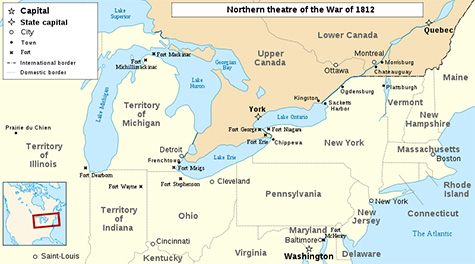
A Three-Pronged Approach In 1812, President Madison approved a plan for invading Canada. William Hull would use Fort Detroit as a base to send troops into Upper Canada. Stephen Van Rensselaer would cross the Niagara River and invade Canada between Lakes Erie and Ontario. And Henry Dearborn would follow Lake Champlain to try to take Montreal. Of course, all three attempts failed. Hull surrendered Fort Detroit to the British, and the militia under Van Resselaer and Dearborn refused to cross into Canada, rendering their armies ineffective.
The Battle of Lake Erie In 1813, the United States decided to try again. By then, a British naval squadron controlled Lake Erie—any invasion of Canada would require control of the lake. A young naval officer named Oliver Hazard Perry was dispatched to Lake Erie, where he constructed a naval squadron along its shores. On September 10, 1813, the British squadron arrived outside the harbor that was home to Perry's fleet. The two fleets opened fire on one another, and in short order Perry's flag ship was badly damaged. Transferring to the Niagara, Perry positioned his new flagship between five British ships. With three on one side and two on the other, Perry ordered his gunners to load and fire at will. One by one the British ships surrendered, leaving the Americans in control of Lake Erie.
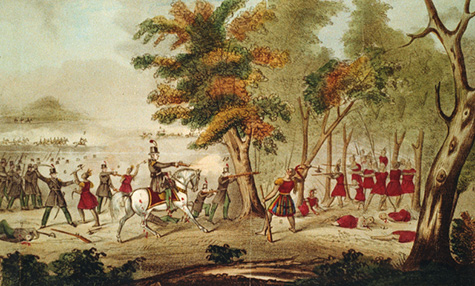
Battle of the Thames William Henry Harrison commanded an army sent to recapture Fort Detroit before invading Canada. With Perry's victory on Lake Erie, Harrison was able to cross into Upper Canada, forcing the British and their Native American allies to withdraw. Harrison caught up to the combined enemy force near the Thames River and ordered his men to attack. The British retreated almost immediately, but the Native Americans, led by Tecumseh, stood their ground and fought. After a hard battle, Tecumseh's warriors were defeated, and Tecumseh himself was killed. Angry at the British for retreating, the Native Americans who had supported Britain ended their alliance. |
 |

![By Wmpearl (Own work) [CC0], via Wikimedia Commons](https://s3.amazonaws.com/cms.accelerate-ed.com/image/b16bb71a-e66a-4c0a-b0e8-241e80429d40.jpg)
Question
How important was control of the Great Lakes for invading Canada?
