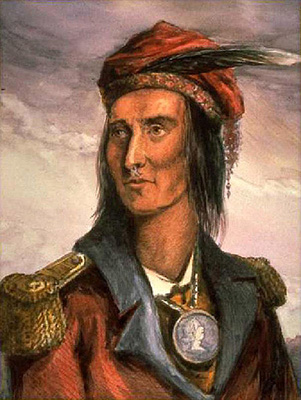
As you know from your previous reading for this course, tensions between European Americans and Native Americans had existed since the founding of the American colonies. Discord was usually caused by disputes over land. After the Americans won the Revolution, the British gave the United States all of its territory between the newly independent states and the Mississippi River. This development sparked new tensions with Native Americans, as more and more whites moved west into the unsettled territory. It was during the push westward that a Shawnee warrior named Tecumseh emerged as a leader for various Native American tribes wishing to keep whites from settling their lands.
Who was Tecumseh, and how did he try to protect Native American lands from white settlement? Study the information on the slides below to learn more.
|
An Early Start Tecumseh's distrust of white settlers started at a young age. In 1774, when Tecumseh was around 6 years old, his father was killed during the Battle of Point Pleasant. Over the next six years, three of the villages he lived in were attacked and destroyed by white settlers. At the age of 15, Tecumseh joined other Shawnee warriors in attacking the boats of white settlers as they came down the Ohio River. In 1791, he and his fellow warriors defeated an American Army sent to subdue the Native Americans at the Battle of the Wabash. Three years later, he and his fellow warriors were defeated by another American Army at the Battle of Fallen Timbers.
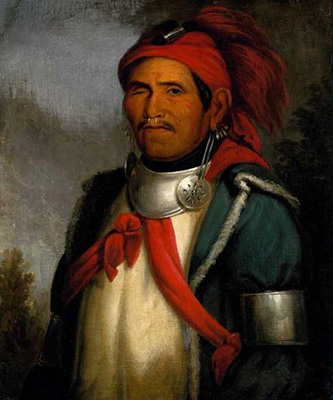
A Prophet Tecumseh had a younger brother named Tenskwatawa. In 1805, Tenskwatawa had a religious conversion after falling into a trance and communicating with the Master of Life, a Shawnee deity. He claimed the Master of Life told him that the Shawnee should give up American customs. If they did, Tenskwatawa explained, the Master of Life would reward them by driving the whites from Shawnee lands. From that point forward, Tenskwatawa was known as "The Prophet."
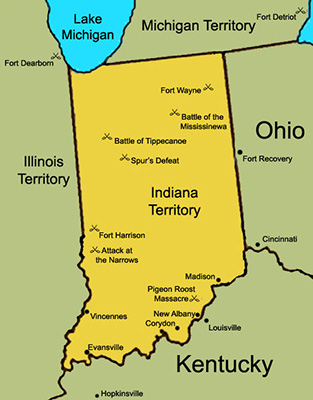
Prophetstown In an effort to avoid white settlers, Tecumseh and his brother moved to the northwestern portion of the Indiana Territory and established a village called Prophetstown. In 1808, Tecumseh started encouraging other Native Americans opposed to the actions of whites to come to Prophetstown and live with him and his brother. Slowly, Tecumseh and the "The Prophet" started to form a confederation of different Native American tribes.
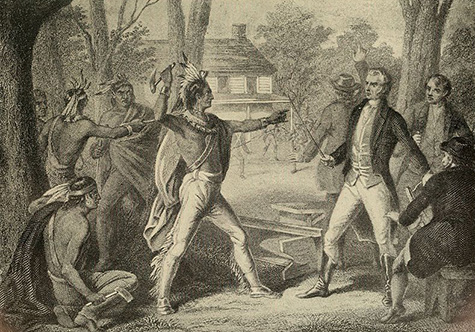
William Henry Harrison William Henry Harrison was the governor of the Indiana Territory in 1809. At that time he negotiated the Treaty of Fort Wayne with several tribes, which gave the United States control of nearly 3 million acres of land. Tecumseh opposed this treaty and met with Harrison in 1810 to voice his concerns. During the meeting Tecumseh told Harrison that if Americans continued to take Native American lands, "I assure you it will be productive of bad consequences."
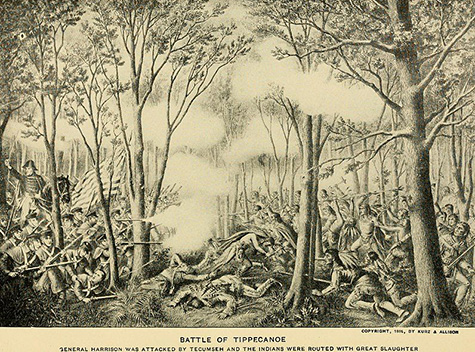
Battle of Tippecanoe In July of 1811, Tecumseh headed south to recruit more tribes for his growing confederation. With Tecumseh gone, William Henry Harrison saw an opportunity to intimidate the Native Americans left behind. Harrison took 1000 soldiers and made camp about a mile from the Prophetstown. When "The Prophet" found out, he ordered his warriors to prepare for battle, telling them that the American bullets could not hurt them. On the night of November 6, 1811, "The Prophet's" warriors launched a surprise attack against the American encampment near the Tippecanoe River. The Native Americans were defeated and Prophetstown was burned. With his confederation in disarray, Tecumseh and "The Prophet" fled to Canada. |
 |

What was the method and the effect of Tecumseh and his brother? Use the activity below to review what you have learned.
Which best describes Tecumseh's early interactions with white settlers?
As a child, Tecumseh saw his father killed and several of his village destroyed by white settlers. These events convinced Tecumseh that Native Americans should prevent whites from settling on their lands.
As a child, Tecumseh saw his father killed and several of his village destroyed by white settlers. These events convinced Tecumseh that Native Americans should prevent whites from settling on their lands.
As a child, Tecumseh saw his father killed and several of his village destroyed by white settlers. These events convinced Tecumseh that Native Americans should prevent whites from settling on their lands.
Which sentence best describes the teachings of "The Prophet?"
"The Prophet" encouraged Native Americans to resist American customs, telling them that if they kept their traditional way of life, the Master of the Life would reward them by removing white settlers from their lands.
"The Prophet" encouraged Native Americans to resist American customs, telling them that if they kept their traditional way of life, the Master of the Life would reward them by removing white settlers from their lands.
"The Prophet" encouraged Native Americans to resist American customs, telling them that if they kept their traditional way of life, the Master of the Life would reward them by removing white settlers from their lands.
Which sentence best describes the outcome of the Battle of Tippecanoe?
The Native American warriors launched a surprise attack against the American camp. The surprise attack did not fool the American Army and the Native Americans were soundly defeated and forced to retreat.
The Native American warriors launched a surprise attack against the American camp. The surprise attack did not fool the American Army and the Native Americans were soundly defeated and forced to retreat.
The Native American warriors launched a surprise attack against the American camp. The surprise attack did not fool the American Army and the Native Americans were soundly defeated and forced to retreat.
You got # out of # correct. Click the Retry button for another attempt.
You got a perfect score. Great job!
