Three days before James Madison was sworn in as president, Congress passed the Non-Intercourse Act, an attempt to force Britain and France to recognize American neutral shipping rights by cutting off trade with both. The act did not have the desired effect—both Britain and France continued to seize American ships and cargo and to impress American sailors, or press them into military service on their own ships.
On May 1, 1810 Congress replaced the Non-Intercourse Act with Macon's Bill No. 2. The new law reopened trade with both Britain and France, but it also stated that if either country recognized American shipping rights, the United States would cut off trade with the other. In November, France agreed to stop harassing American trade ships, so the United States stopped trading with Britain. However, neither Britain nor France stopped interfering with American trade at sea.
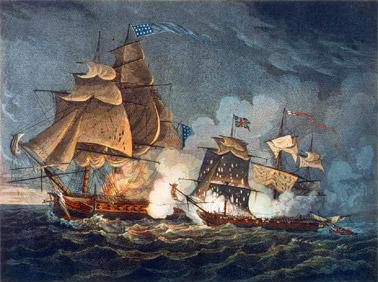 |
| Little Belt Affair |
In May of 1811, the American warship the President began patrolling the U.S. coast in search of the British warship Guerriere, which had impressed American citizen John Diggio from another ship a couple of weeks earlier. On May 16, the captain of the President, John Rogers, spotted a British ship in the distance and, thinking it was the Guerriere, gave chase. The vessel he was actually chasing, though, was a much smaller British ship called the Little Belt. Around 10:15 pm a shot was fired from one of the ships. The Little Belt was badly damaged during the short battle that ensued. Once the battle was over, each side claimed the other had fired the first shot.
Another dispute between the United States and Britain involved a secret attempt by the British to persuade parts of the United States to secede. In February of 1812, President Madison purchased some letters from a man named John Henry, who had been hired by the governor of Canada to see if disgruntled Federalists in New England would be interested in joining the British Empire. Henry had reported his findings to the governor of Canada in a series of letters. When the governor died, Henry offered to sell the letters to Britain. The British refused to buy them, so Henry offered them to the United States. President Madison paid $50,000 for the letters, which he shared with Congress.
Can you see why the United States and Britain might be led to believe that they should be enemies? Use the following activity to review what you have learned.
|
What did Macon's Bill No. 2 do?
|
cut off trade with Britain and France
restore trade with Britain and France
declare war on Britain
|
|
Why was the American warship President looking for the British warship Guerriere?
|
The Guerriere had impressed an American citizen from another ship.
Guerriere had sunk another American warship.
Guerriere had seized the cargo from an American trade ship.
|
|
What part of the United States did John Henry think might secede and join the British Empire?
|
Mid Atlantic
the South
New England
|
Complete
