On June 1 of 1812, President Madison went before Congress, asking for a declaration of war with Britain. While some older Democratic-Republicans were critical of the idea, most of the opposition came from the Federalists. Federalists had always favored closer ties with Britain, and a war would jeopardize those ties. It would also push the United States closer to France and its power-hungry dictator Napoleon.
Most Federalists in Congress represented the New England states, and the economies of those state relied very heavily on manufacturing and shipping. Although the on-going British interference with American trade hurt their economy, the New England states worried that a war with Britain would curtail all American trade. The British would most surely use their large navy to blockade the American coast, closing off all American ports. And of wars cost money—the Federalists argued that the United States could not afford to wage war against the British.
 |
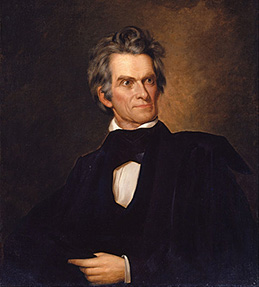 |
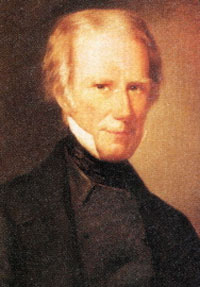
| Henry Clay | John C. Calhoun |
By 1812, a young crop of Democratic-Republicans had been elected to Congress from the Southern and Western states. These younger members, such as Henry Clay of Kentucky and John C. Calhoun of South Carolina, supported the war, and were therefore known as War Hawks. The War Hawks argued that the British had been working actively against American interests by instigating Indian raids along the American frontier. They did not think it was a coincidence that Tecumseh and "The Prophet" fled to British-owned Canada after their defeat at the Battle of Tippecanoe. The War Hawks suggested that a war with Britain might end those raids while possibly allowing the United States to acquire new territory, such as Canada or Florida. All this new territory, they reasoned, would strengthen the American economy by providing more fertile land for American farmers.
Despite Federalist opposition, the House of Representatives voted 79 to 49 on June 4 to go to war with Britain. Two weeks later, after a few delays managed by Federalists and older Democratic-Republicans, the Senate voted 19 to 13 in favor of the war. On June 19, 1812 President Madison proclaimed that a state of war existed between the United States and Britain.
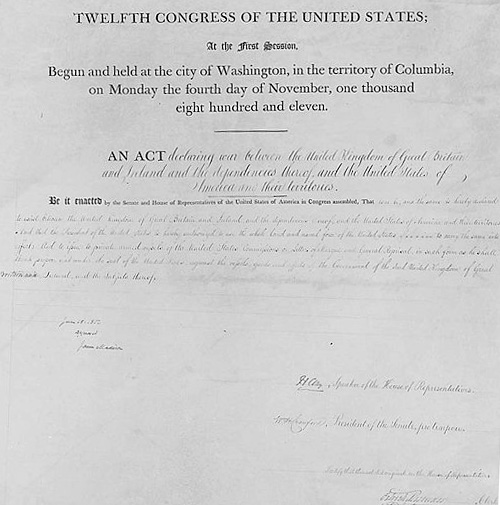 |
| Declaration of War Against Britain |
Use the Hidden Answer Table below to review the Federalist and War Hawk positions regarding war with Britain. First try to answer the question on your own, in your mind. Then click the question to check your answer.
| Which states did most War Hawk members of Congress represent? | War Hawks represented mostly Southern and Western states. |
| What did Federalists think would happen to American trade if the United States went to war with Britain? | Federalists feared that all American trade would be cut off because the British would use their navy to blockade the American coastline. |
| Why did the War Hawks want the United States to use a war with Britain to add territory to the United States? | War Hawks wanted new territory so American farmers would have more land to plant and harvest. |
| Did New Englanders support or oppose a war with Britain? | Most New Englanders were Federalists, and, therefore, opposed a war with Britain. |
