President Madison was re-elected to a second term five months after the War of 1812 began, and most of his second term was focused on fighting the war against Britain. Once peace was achieved, though, Madison turned his attention to strengthening the American economy. The First Bank of the United States had been forced to close in 1811 over concerns of large British investments in the Bank. And British interference with American trade before and during the war had hurt American manufacturers and shippers.
In December of 1815, President Madison delivered an address to Congress with three suggestions for making the American economy stronger: create a new national bank, increase tariffs on foreign goods, and improve transportation within the United States. These three ideas are known as the American System.
When the First Bank of the United States closed, central regulation of American currency also ended. More state banks were created as a result, and these state banks issued large numbers of bank notes. Banks had to keep a certain amount of gold and silver coins on reserve to pay anyone cashing in a note. During the War of 1812, large numbers of people worried about their money, so they went to the banks to cash in their notes. Eventually the banks did not have enough gold and silver coins to honor all the notes they had issues, so they stopped redeeming them. This is also known as suspending specie payments, as coins were specie.
President Madison was concerned about the impact of these suspensions on the nation's economic health and believed that a new national bank would help stabilize the economy overall. Madison convinced Congress that his plan was a good one, and on April 10, 1816, he signed a bill creating the Second Bank of the United States. This new bank would provide better regulation of currency than the state banks.
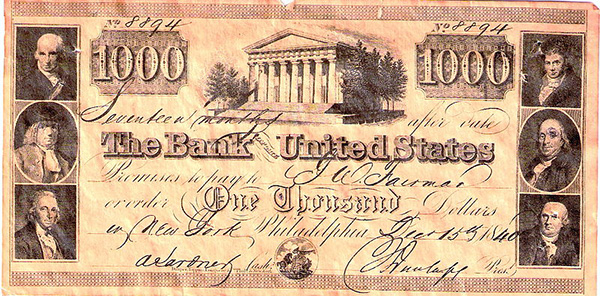 |
| Bank note issued by the Second Bank of the United States. |
President Madison also favored the use of tariffs, or taxes on goods from other countries. Typically, governments use tariffs to raise revenue, but high tariffs can also be used to discourage people from buying foreign made goods. British interference with American trade before and during the War of 1812 had hurt American manufacturers.
To help manufacturers recover, President Madison suggested raising the tariff on foreign goods so that Americans would buy more American goods. If the tariff passed, American manufacturers would also be protected from foreign competition. In April of 1816, Congress agreed to pass a new Tariff Act. The law imposed a 25% tariff on cottons and woolens and a 30% tariff on iron, leather, and other products. It was the first protective tariff in American History.
Finally, Madison felt that an improved internal transportation system might boost the economy by making it easier for manufacturers to get their raw materials and to get their products to customers. While Madison supported improving the country's transportation system in his message to Congress, he had a change of heart by the time the bill was passed. Known as the Bonus Bill, the law approved $1.5 million for internal improvements such as road and canal construction. Madison did not believe the Constitution empowered the national government to spend money on roads and canals, so he vetoed it. This was his last action as president.
Question
Is the "American System" an appropriate title for the recommendations made by President Madison in his address to Congress?
