In 1804, Aaron Burr was serving as vice president of the United States. Prior to the election of 1800, Burr had been very active in New York politics, serving first as the state's attorney general and then as a United States Senator.
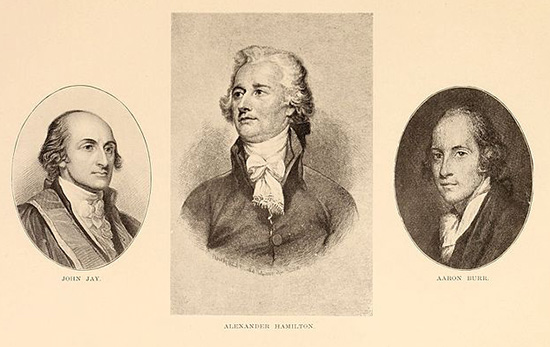
Burr had never gotten along with Alexander Hamilton, who had retired from public life at the end General Washington's second term. Hamilton was a Federalist, and Burr was a Democratic-Republican. Furthermore, as political rivals, each did things to aggravate the other. In 1800, Burr published a letter that Hamilton had written criticizing his fellow Federalist, President John Adams. Hamilton had intended the letter for private circulation among his closest political allies and was embarrassed when it was made public.
For his part, Hamilton had encouraged the Federalist members of the House of Representatives to choose Jefferson over Burr when the two men tied in electoral votes in the Election of 1800. Deep down, Burr had ambitions to be president, so Hamilton's influence in deciding the outcome did not sit well with him.
In February 1804, Hamilton was at a dinner party where Burr's name came up in conversation. According to others at the party, Hamilton accused Burr of being "a dangerous man, and one not to be trusted with the reins of government." When Burr found out that Hamilton had criticized him, he demanded an apology. Hamilton responded to Burr's demands but did not apologize. Unsatisfied, Burr challenged Hamilton to a duel, and Hamilton accepted the challenge.
Dueling was illegal in New York, so the two men met on dueling grounds in Weehawken, New Jersey on July 11, 1804. Hamilton fired first and missed. Burr returned fire hitting Hamilton in the abdomen. Hamilton died the next day.
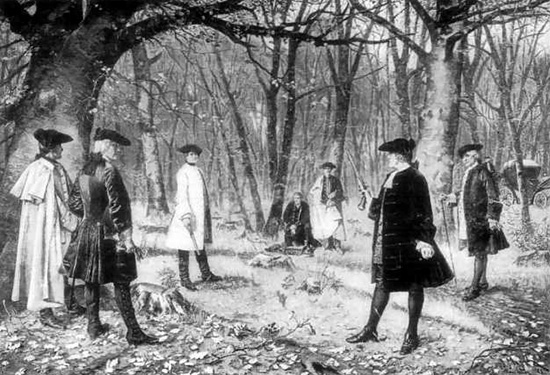 |
| The Hamilton-Burr Duel |
Burr was charged with murder in New Jersey and New York, but escaped trial by staying away from both states. He eventually returned to Washington, D.C. to continue serving as vice president. However, President Jefferson and the Democratic-Republicans had grown disenchanted with Burr, and they dropped him as Jefferson's vice presidential running mate for the Election of 1804.
Question
Was the duel between Hamilton and Burr justified?
