In May of 1803 Britain declared war on France. While the two countries had enjoyed a brief period of peace, Napoleon's ambitions to rule all of Europe could not be ignored by the British. The United States was careful to assert its neutrality in the conflict, and its the intention to continue trading with both countries.
Neither Britain nor France liked having the United States trade with their enemy, so each tried to limit American trade to the other. With a larger navy, the British were more effective at stopping American trade ships and seizing their cargo. With less cargo reaching France, American shippers complained they were losing money.
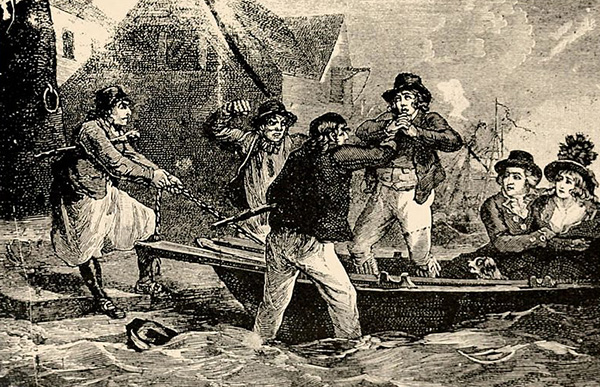 |
| A sailor being impressed. |
But cargo wasn't the only thing being seized by the British. Facing a shortage of manpower, the British had resumed their practice of seizing sailors from American ships and forcing or "pressing" them to enlist in the British Navy. Known as impressment, this practice was only supposed to target British sailors who had deserted. But many American sailors were also impressed and forced to join the British Navy. By one estimate, 10,000 men were impressed during this period, but only 1000 of them were actually British.
In response to renewed British interference with American trade, President Jefferson instructed James Monroe and William Pinkney to negotiate a treaty with the British that would settle these differences. The result was the Monroe-Pinkney Treaty.
Use the list below to examine the terms of the Monroe-Pinkney Treaty. Click each area of disagreement or dispute in the left column to see how the treaty resolved the issue.
| To address the disruption of American trade . . . | the treaty lowered duties Americans had to pay in British ports and gave Americans continued access to trade in the British East Indies. |
| Regarding American cargo seized by the British . . . | the treaty made no mention. American shippers were not reimbursed for seized cargo. |
| Regarding the impressment of American sailors . . . | the treaty made no mention. The fate of these sailors was not addressed. |
Question
How do you think President Jefferson reacted to the terms of the Monroe-Pinkney Treaty?
