 |
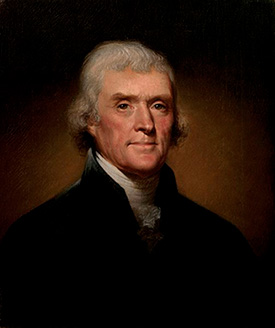
| Official presidential portrait of Thomas Jefferson |
In the context of politics, the word revolution usually refers to a sudden, radical, or complete change. Before the election of 1800, the Federalists effectively controlled all three branches of the government. After the election, the Democratic-Republicans controlled the presidency, the vice presidency, and both houses of Congress. The only part of the government still in Federalist hands after the election was the judicial branch, and that was only President Adams managed to appoint several Federalists as judges before leaving office.
While there wasn't much that President Jefferson and his fellow Democratic-Republicans in Congress could do about the Federalists controlling the judicial branch, they quickly set about changing many of the laws that had been enacted under President Washington and Adams. They had some laws repealed and changed the way others were being enforced. These "sudden, radical, and complete changes" are referred to by many historians as The Revolution of 1800.
Use the chart below to learn more about the changes that the election of 1800 brought. Click each "before" statement to see how the status quo was changed by Jefferson's administration.
| Before 1800 | After 1800 |
|---|---|
| The tax on whiskey was a major source of revenue for the national government. | In 1802, Jefferson convinced Congress to repeal the whiskey tax. |
| Both the army and the navy increased in size due to growing tensions with France. | Both the army and the navy were drastically reduced. |
| The Alien Friends and Alien Enemies Acts enabled the president to deport suspicious foreigners. | Jefferson refused to enforce either law. |
| The Naturalization Act made foreigners wait 14 years to become U.S. citizens. | Jefferson convinced Congress to repeal the act in 1802. |
| 10 people had been convicted under the Sedition Act for criticizing the government. | Jefferson pardoned all 10 who were convicted. |
Question
How do you think people reacted to the drastic changes being ushered in by President Jefferson?
Federalists, on the other hand, were extremely upset about Jefferson's efforts to repeal or ignore all of the laws they had worked so hard to enact.
