In one way, the presidential election of 1800 was very similar to the election of 1796: It was a rematch between Federalist John Adams and Democratic-Republican Thomas Jefferson. There was a key difference as well—for the first time, each party named a vice presidential candidate. The parties hoped to ensure that the president and vice president would be more aligned in their political views than in previous administrations. Charles Cotesworth Pinckney was chosen by the Federalists, and Aaron Burr was chosen by the Democratic-Republicans.
When the electoral votes were counted, Jefferson and Burr tied with 73 votes each. Adams received 65, and Pinckney received 64. According to the Constitution, in the event of a tie, the House of Representatives chooses the president. The Federalists were still in control of the House of Representatives, and some wanted to vote in a way that would disrupt the Democratic-Republican plan for Jefferson to be president and Burr to be vice president.
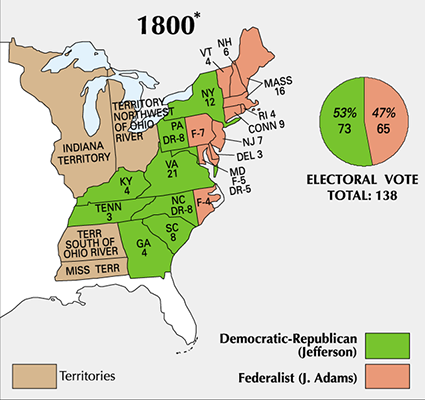 |
| Map showing the distribution of the electoral votes in 1800 |
On February 11, 1801 the House of Representatives cast its first ballot. With each state casting one vote, a candidate would need nine votes to be declared the winner. Jefferson received eight votes, Burr received six votes, and two states were divided and therefore cast no votes. The House voted eighteen more times that day without determining a winner.
Deadlocked, the House of Representatives adjourned for a few days to regroup. The Federalists were unsure how to proceed, so they asked their leader, Alexander Hamilton, for advice. Hamilton encouraged his fellow Federalists to choose Thomas Jefferson, expressing the view that "Jefferson is in every view less dangerous than Burr." On February 17, 1801 Jefferson was elected president on the 36th ballot, which meant that Burr would become vice president.
Question
Why did it take the House of Representatives 36 ballots to decide the winner of the Election of 1800?
