Meiosis is a unique kind of cell division that only happens in germ line cells--the cells involved in reproduction that take the form of sperm cells in male organisms and egg cells in female organisms. What is unique about these cells and their approach to cell division? Consider that each germ line cell needs to contain half of the DNA needed to form the zygote that will become a new organism. Mitosis produces cells with all the DNA of the "parent" cells, so another process is needed--a process that reduces the number of chromosomes in a cell.
In meiosis, a diploid cell, which contains 46 chromosomes in humans, produces four haploid cells, which, in humans, each contain 23 chromosomes. Meiosis is sometimes called reduction because the chromosomal number is reduced at the end of the process.
Before meiosis begins, a germ cell progresses through the G1, S and G2 phases that also happen during mitosis, and pairs of chromosomes are duplicated. By the end of G2, human sperm and egg cells have 92 chromosomes each, and they split into two cells, each containing 46 chromosomes. Next, both new cells enter the process of meiosis, producing four haploid sperm or egg cells with only 23 chromosomes each. Study the diagram below, which illustrates what happens during meiosis.
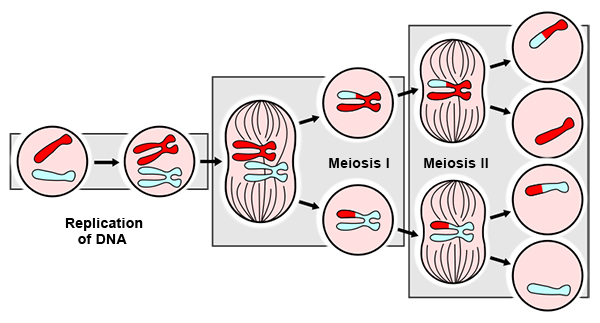
Let's suppose that the red chromosome in this diagram is composed of genetic material that the organism received from its mother, while the blue chromosome is composed of genetic material that the organism received from its father. By the conclusion of meiosis I, each chromosome includes a mixture of maternal and paternal genes, or chromatids. When the diploid cell divides to form four haploid cells, during meiosis II, some cells contain genetic material from both the organism's parents.
Question
Why don't you look exactly like one of your parents? Why are children born with genetics that differ from their parents, causing some children to appear more similar to their grandparents?
