Consider this everyday occurrence: a woman begins the process of giving birth while her parents and other relatives wait in another room, anxious for news about the baby. What they’re waiting to hear is if the baby is healthy and perhaps whether the child is a girl or a boy. They have little doubt, however, that the woman will deliver a human baby. That is because every baby born to a human being is also a human.
In a scientific sense, this certainty can be attributed to the chromosomes inside the nucleus of each organism’s cells. If you analyze the body cell of a human baby, you will find exactly 46 chromosomes inside its nucleus. Several other animals have 46 chromosomes in each cell, but they are not the same combination of chromosome types found in a human body cell. A human baby is human because its chromosomes are numbered and arranged in a way unique to humans.
The diagram below, called a karyotype, illustrates the arrangement of the chromosomes found in each human cell.
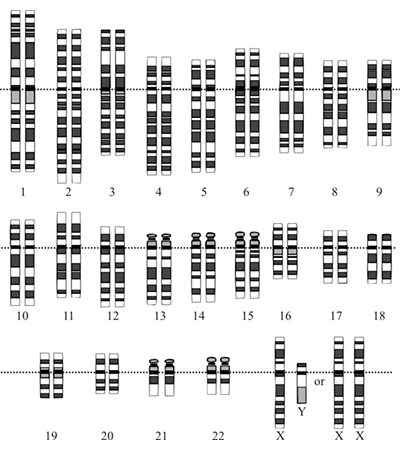
The first thing you may notice about the human karyotype is that the chromosomes appear as pairs. Every chromosomal pair is equal in size and length except, in male humans, the pair that determines sex. The symbol XY at chromosome 23 indicates that this cell belongs to a male human. If XX appears at chromosome 23, then the cell belongs to a female human.
Each pair of chromosomes, including the ones that determine sex, are called homologous chromosomes. Each homologous chromosome pair contains one paternal chromosome (contributed by the human’s father) and one maternal chromosome (contributed by the human’s mother). In general, when you study a karyotype like the one above, the chromosome on the left is maternal, and the chromosome on the right is paternal.
Question
How did scientists discover meiosis?
