Meiosis is composed of two major stages, known as meiosis I and meiosis II. Each phase of meiosis (prophase, metaphase, anaphase, and telophase) happens twice--once in each stage--before the entire process of meiosis is complete. The tabs below illustrate how each stage occurs.
Let's say that the cell shown in the diagrams is an egg-producing cell that is poised to create four egg cells through meiosis. Remember that a woman producing egg cells is passing along chromosomes from both her father and her mother. Think of the red chromosome in each pair as the maternal chromosome and the blue chromosome as the paternal chromosome.
Meiosis I
Meiosis II
Click on the image of each stage of Meiosis I to reveal what occurs during that stage.
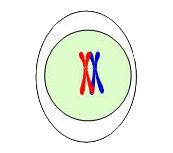 Prophase I |
The duplicated homologous chromosomes pair up and exchange their chromatid segments. What you see is a tetrad formation that allows the exchange of chromatid segments between the non-sister chromatids (red chromosomal sister chromatids are non-sister chromatids to the blue sister chromatids). This process is called crossing over--it ensures that a female's egg cell will contain a mixture of her father's and mother's chromosomes, thereby conferring family characteristics to any potential children. After the prophase, the cell is in a diploid condition--it has two sets of chromosomes (2n). |
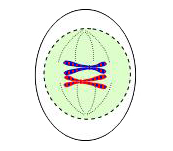 Metaphase I |
The chromosomes line up by homologous pairs. This movement is facilitated by the spindle fibers, similar to this part of the process in mitosis. The spindle fibers are made by centrosomes and are attached to the centromeres of the chromosomes. |
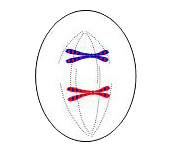 Anaphase I |
Each pair of homologous chromosomes separates as the spindle fibers shorten and pull the pairs apart. |
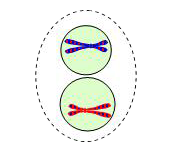 Telophase I and Cytokinesis |
Notice that each chromosome still has two sister chromatids. However, one or both of the chromatids includes regions of non-sister chromatid DNA from other parent. Two haploid cells begin to form. When cytokinesis begins, the cells pinch off, forming two cells. The two cells are now in a haploid condition, with one set of chromosomes each. |
Click on the image of each stage of Meiosis II to reveal what occurs during that stage.
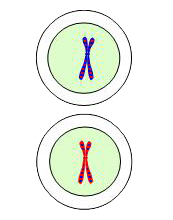 Prophase II |
Spindle fibers reform and attach to the haploid chromosomes. These haploid chromosomes are now genetically different from their original state. They are poised to separate into four haploid daughter, or egg, cells. |
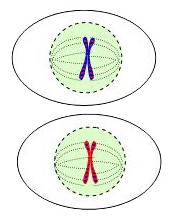 Metaphase II |
Similar to what happens during mitosis, the chromosomes settle on a metaphase plate. |
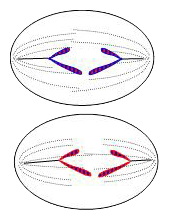 Anaphase II |
As the proteins holding them together break down, the sister chromatids separate. These separating sister chromatids will be allocated into different cells. As the spindle fibers shorten, the separated sister chromatids move towards the ends, or poles, of the cell. |
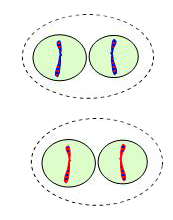 Telophase II and Cytokinesis |
By the end of cytokinesis, four haploid daughter cells are formed. Each has one chromosome. The cell started with two chromosomes, and now it has made four cells with one chromosome each. This process is a diploid-to-haploid change, the essential job of meiosis. |
