Mitosis and meiosis are very similar in some ways--both processes involve cell division and the redistribution of chromosomes. As this lesson has shown you, though, there are key differences between the two. Make sure you understand the finer points of the cell division processes that happen in your body all the time. Read each question below, and decide on an answer--for both meiosis and mitosis--before clicking the question to check your answer.
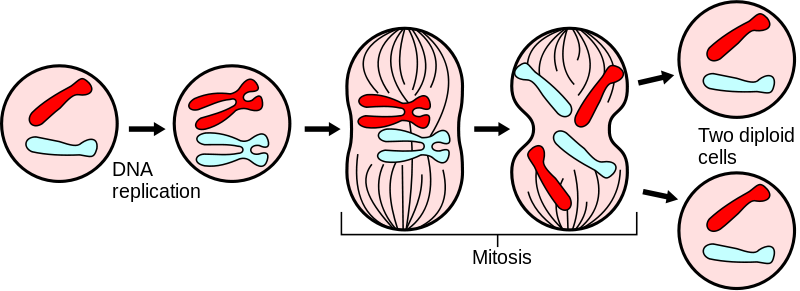
|

|
| (Click on the images to enlarge) | |
| Mitosis | Meiosis | |
| Where does the process happen? | somatic cells (body cells) | germ line cells (reproductive cells) |
| How many cell divisions occur in the process? | one round of divisions | two rounds of divisions |
| Does crossing over or pairing of homologous chromosomes happen? | no | yes, in prophase I |
| Does the process produce daughter cells that are genetically identical to the parent cells? | yes | no |
| How many daughter cells are made at the end of the cell division? | two | four |
| How many chromosomes are present in the daughter cells? | A diploid number (2n), where n stands for a single set of chromosomes of the organism. In humans it is 2 x 23 = 46 chromosomes. | A haploid number (n), where n stands for a single set of chromosomes of the organism. In humans it is 1 x 23 = 23 chromosomes. |
| What function does this process serve in the human body? | It helps in the growth, repair, and regeneration of body tissue. | It helps in producing sperm and egg cells for reproduction. |
