You can use the same steps to analyze a secondary source as you used to analyze a primary source. First, read the background information on the source so that you can look at the account in its historical context. Then, identify the author and the audience. Finally, compare the source to other accounts or other evidence that you find.
 Background:
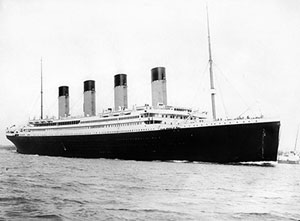
In 1955, historian Walter Lord published A Night to Remember, a story about what happened the night the Titanic sank. Lord had been fascinated with the Titanic disaster ever since he was 10 years old, and spent much of his free time researching, drawing, and thinking about the doomed ship. To recreate that night, Lord interviewed more than 60 Titanic survivors, and devoted years to researching the event. He eventually became one of the world's top experts on the tragedy, even advising director James Cameron for his 1997 film, Titanic.
In this excerpt, Lord describes how a lifeboat of First Class passengers set off from the wrecked ship with 70 percent of its seats empty.
Words to Know:
Punctilious: very concerned with details or correct behavior
Aft: toward the stern (back) of a ship
Davits: small cranes used to lower lifeboats
Caustically: in a sharp or bitter manner
The scene was almost punctilious at [lifeboat] No. 1. Sir Cosmo Duff Gordon, his wife and her secretary Miss Francatelli-- whom Lady Duff Gordon liked to call Miss Franks-- asked Murdoch if they could enter.
"Oh, certainly do; I'll be very pleased," Murdoch replied, according to Sir Cosmo. (On the other hand, Lookout George Symons, standing near, thought Murdoch merely said, "Yes, jump in.") The two Americans, Abraham Solomon and C.E.H. Stengel, came up and were invited in too...
Nobody else seemed to be around--all the nearby boats were gone and the crowd had moved aft. When the five passengers were safely loaded, Murdoch added six stokers, put Lookout Symons in charge and told him, "Stand off from the ship's side and return when we call you." Then he waved to the men at the davits, and they lowered No. 1--capacity 40 persons--with exactly 12 people.
As the boat creaked down, Greaser Walter Hurst watched it from the forward well deck. He remembers observing somewhat caustically, "If they are sending the boats away, they might just as well put some people on them."
From A Night to Remember by Walter Lord, 1955
What does Lord's account show about life in 1912, the historical context for the event?
- Neither rich nor poor people knew how to swim in 1912.
- Third Class (poorer) passengers were more likely to be rescued in 1912.
- First Class (richer) passengers were more likely to be rescued in 1912.
- Lifeboats built around 1912 were more likely to sink when filled to capacity.
Most people in 1912 assumed that First Class passengers should be rescued first, since their lives were considered more valuable. In modern historical contexts, this approach to a disaster seems cruel and unfair.
Most people in 1912 assumed that First Class passengers should be rescued first, since their lives were considered more valuable. In modern historical contexts, this approach to a disaster seems cruel and unfair.
Most people in 1912 assumed that First Class passengers should be rescued first, since their lives were considered more valuable. In modern historical contexts, this approach to a disaster seems cruel and unfair.
Most people in 1912 assumed that First Class passengers should be rescued first, since their lives were considered more valuable. In modern historical contexts, this approach to a disaster seems cruel and unfair.
What part of Lord's account shows that he is probably a reliable source of information about the launching of lifeboat Number 1?
- Lord believes that the Titanic was doomed by a curse.
- Lord was there on the Titanic when it sank, and survived to tell the true story he witnessed.
- Lord ignores the testimony from the Third Class passengers.
- Lord includes and compares several points of view about what happened.
Walter Lord wasn't there on the Titanic, but his effort to tell all sides of the story shows that he doesn't automatically believe whatever he's told. This makes his secondary source account more reliable.
Walter Lord wasn't there on the Titanic, but his effort to tell all sides of the story shows that he doesn't automatically believe whatever he's told. This makes his secondary source account more reliable.
Walter Lord wasn't there on the Titanic, but his effort to tell all sides of the story shows that he doesn't automatically believe whatever he's told. This makes his secondary source account more reliable.
Walter Lord wasn't there on the Titanic, but his effort to tell all sides of the story shows that he doesn't automatically believe whatever he's told. This makes his secondary source account more reliable.
What part of Lord's account is probably not 100 percent accurate?
- The characters in the story are probably not the same people who were really there.
- The number of people in lifeboat Number 1 is probably just an estimate--not an exact number.
- The quotes that people provided are probably not always exactly what was said during the incident.
- All of the above
Walter Lord was very careful to get the names and numbers of the people involved in his account correct. However, he relied on eyewitnesses to tell him what various people said during the rescue. Since Lord interviewed survivors 40 years after the disaster, they probably don't remember exactly what was said.
Walter Lord was very careful to get the names and numbers of the people involved in his account correct. However, he relied on eyewitnesses to tell him what various people said during the rescue. Since Lord interviewed survivors 40 years after the disaster, they probably don't remember exactly what was said.
Walter Lord was very careful to get the names and numbers of the people involved in his account correct. However, he relied on eyewitnesses to tell him what various people said during the rescue. Since Lord interviewed survivors 40 years after the disaster, they probably don't remember exactly what was said.
Walter Lord was very careful to get the names and numbers of the people involved in his account correct. However, he relied on eyewitnesses to tell him what various people said during the rescue. Since Lord interviewed survivors 40 years after the disaster, they probably don't remember exactly what was said.
What are the important parts of an accurate secondary source?
- Careful research
- Accurate interviews
- An objective frame of reference
- All of the above
For a secondary source to be reliable, it has to be built on close research of primary sources, have an open mind to new discoveries, and show an awareness that parts of the story may be unknown.
For a secondary source to be reliable, it has to be built on close research of primary sources, have an open mind to new discoveries, and show an awareness that parts of the story may be unknown.
For a secondary source to be reliable, it has to be built on close research of primary sources, have an open mind to new discoveries, and show an awareness that parts of the story may be unknown.
For a secondary source to be reliable, it has to be built on close research of primary sources, have an open mind to new discoveries, and show an awareness that parts of the story may be unknown.
Summary
 Questions answered correctly:
 Questions answered incorrectly:
