Why is it so important to get history right? Who cares if Ramesses II lied about some battle 2,000 years ago, or if Thomas Edison gets credit for something he didn't invent? How does that affect people today?
The study of history is not just about connecting dates and names to events from long ago. It's about figuring out how societies work, and how people might act under similar circumstances in the future. If you want to know how people will respond to a disaster, or how far some leaders will go to stay in power, you can't just run an experiment in a lab or ask people to fill out a survey. History offers us the biggest and most accurate collection of evidence about how human beings usually behave, especially in groups. One of the best examples of poor source analysis by ordinary citizens occurred in the early part of the 20th century--just eighty years ago
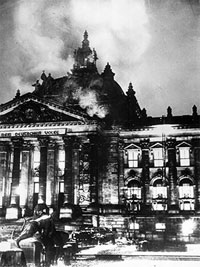 In 1933, a fire broke out in the Reichstag building in Berlin, burning it to the ground. The Reichstag is where the German parliament met, and the attack seemed like a serious threat to the government. The new chancellor of Germany, Adolf Hitler, blamed the fire on a Communist uprising. He convinced the president of Germany that the only way to find and punish those responsible was to take away citizens' rights. The Reichstag Fire Decree read:
Articles 114, 115, 117, 118, 123, 124 and 153 of the Constitution of the German Reich are suspended until further notice. It is therefore permissible to restrict the rights of personal freedom, freedom of expression, including the freedom of the press, the freedom to organize and assemble, the privacy of postal, telegraphic and telephonic communications. Warrants for House searches, orders for confiscations as well as restrictions on property, are also permissible beyond the legal limits otherwise prescribed.
With civil rights no longer protected by Germany's constitution, Hitler's Nazi party began beating up or jailing everyone who disagreed with them. Before long, Hitler was the dictator of Germany, making whatever laws he wanted and preparing to start the bloodiest war in history. Without the Reichstag Fire Decree, Hitler would have found it difficult to gain as much power as he did, and World War II may never have happened.
Imagine how the average citizen in Germany felt, waking up one day to find out that everyone's rights had been taken away. Many Germans were probably suspicious of the reasons behind the decree. (We now know that it was most likely the Nazis themselves, and not members of the Communist party, who started the Reichstag fire.) However, it was too late for German citizens to do much about it once the decree was signed. Their president had failed to question the source of Hitler's version of the Reichstag fire, and that lack of analysis cost Germany and the rest of the world a great deal.
Question
How could better source analysis have helped prevent Hitler's rise to power?
