The Chicano movement was driven forward by actions like the Chicano Blowouts, but it also generated momentum as a nationalist movement, which means many Chicanos thought of themselves as a political force that may or may not deserve its own country. One of the biggest ideas behind Chicano nationalism was Aztlán, the legendary home of the Aztec civilization in Meso-America.
While many members of the Chicano movement simply wanted equal respect from their neighbors and the American government, some dreamed of a new country based on Aztlán and the idea that Mexican racial heritage gave some people a basic right to the land of Mexico and the American Southwest. A few extremists even claimed that non-Mexican people should be driven from the territory.
Here's a map of what some Chicano nationalists envisioned:
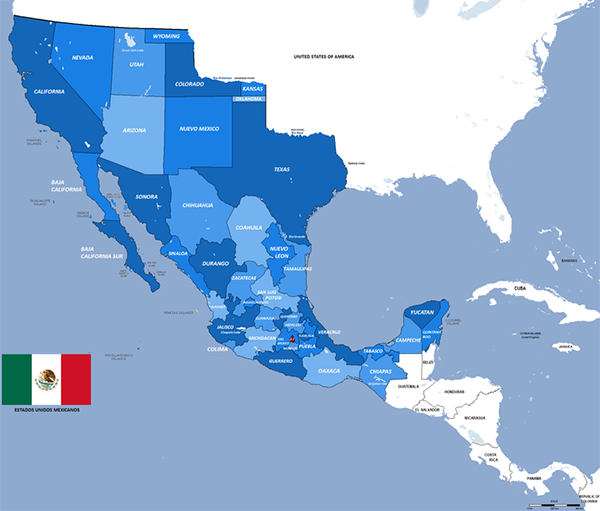 In this imaginary map, the United States is separated from the American Southwest, which becomes part of the "United States of Mexico." |
The man who helped create this political definition of Chicano was a Mexican-American activist named Rodolfo "Corky" Gonzales, who wrote the famous poem "Yo Soy Joaquin." Published around the country in 1967, the poem connected modern Mexican-Americans with the Pre-Columbian civilizations of Meso-America and the Spanish colonizers who settled among them.
Some Chicano activists were serious about their right to the land, and they protested for it. But others were simply proud of their heritage and channeled that pride into art.
Test your understanding of the concept of Aztlán by answering these questions:
What did Aztlán mean to the Aztecs, and what did it mean to members of the Chicano movement?
Did the idea of Aztlán change how Mexican-Americans viewed the American Southwest?
| Your Responses | Sample Answers |
|---|---|
| To the ancient Aztecs, Aztlán was a legendary home for their people. The Chicano movement adopted Aztlán as the name for the land that they imagined they had a racial claim to. | |
| To some Mexican-Americans, the idea of Aztlán was a new way to interpret their surroundings. Instead of second-class citizens in states like Texas and Arizona, they might be the inhabitants of an occupied nation. From a less extreme viewpoint, they might be people with the most significant cultural and racial ties to the land around them. |
