The Zoot Suit Riots were the most obvious example of discrimination in the American Southwest at the time. Many Mexican-Americans were injured in the riots, and the press called the event the "Zoot Suit Riots" despite the fact that white soldiers, not Mexican teens, were the ones doing the rioting. But discrimination was widespread in the region, even when violence wasn't attracting attention.
The event that brought this discrimination to national attention was the Longoria Affair, a 1949 incident in Texas involving the burial of an American soldier.
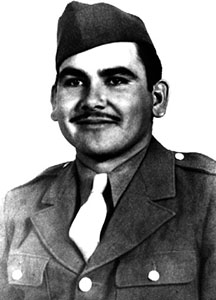 Felix Longoria in his military uniform. |
When Longoria's family contacted the local funeral home to set up a wake, the owners wouldn't allow a viewing to take place in the building itself because Longoria was Mexican, and according to one owner, "the whites would not like it." The refusal exploded into a national scandal with people around the country questioning how a funeral home could disrespect a soldier who died in combat. To resolve the issue, Texas Senator (and future American President) Lyndon Johnson arranged for Longoria to be buried in Arlington National Cemetery outside Washington, D.C.
The Longoria Affair resonated with Mexican-Americans across the country and received coverage in Mexico, too. Just a year earlier, Dr. Hector Garcia had founded the American GI Forum to deal with discrimination against Latino veterans of World War II, and the Longoria Affair became the group's rallying cry. As a result of the scandal, Mexican-Americans began organizing into groups, sharing new bonds of community, and planning to demand more respect and rights from their society.
Use the following questions to review the Longoria Affair and its aftermath.
Why was Felix Longoria's treatment in Three Rivers, Texas, considered outrageous?
What was the response locally and nationally to the Longoria Affair?
| Your Responses | Sample Answers |
|---|---|
| Longoria died overseas while fighting for the United States during World War II, and he was especially unlucky, dying just over a week after he deployed there. The idea that Longoria's race was considered more important than his service outraged people around the country. | |
| In Texas, Senator Lyndon Johnson eased tensions by giving Longoria an honorable burial in Arlington National Cemetery, but Mexican-Americans reacted to the incident by organizing and beginning to demand more respect. |
