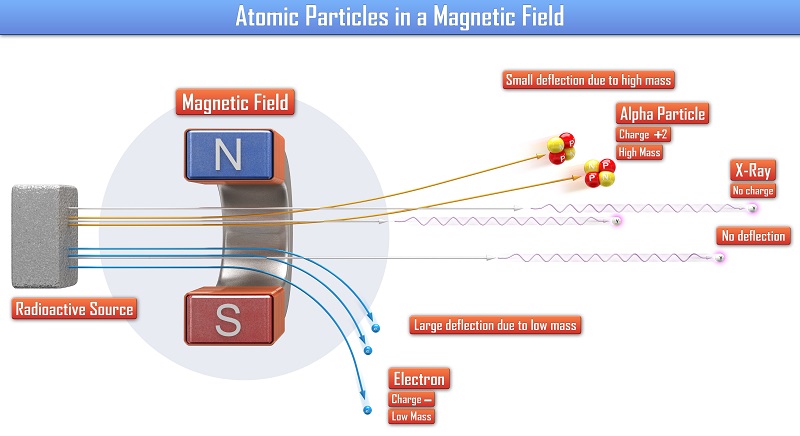
Further testing revealed that there are actually several types of radiation: alpha, beta, and gamma. Alpha rays have a positive charge, beta rays have a negative charge, and gamma rays are neutral. Scientists figured this out by passing the beam of particles through a magnetic field and each was deflected (or not) depending on the charge. This testing revealed that the alpha rays were actually a beam of Helium nuclei and beta rays are actually a beam of electrons. Gamma rays, however, are neither of these, but a beam of photons in a frequency higher than X-rays.
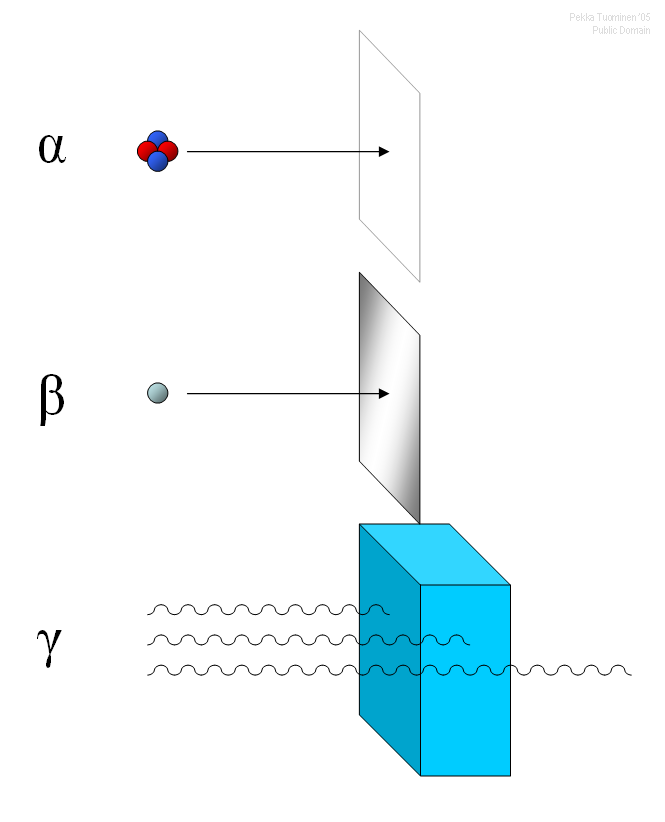
Further testing revealed that alpha particles, because of their size and energy, cannot pass through even a thin sheet of paper; thus, they are not as dangerous as other forms of radiation. Beta rays can pass through paper, but are stopped by a sheet of metal. Since it requires more barrier, they are more dangerous than alpha rays. Gamma rays are the most dangerous, as they can pass through even a piece of lead that is several centimeters thick. Gamma rays have the shortest wavelength on the electromagnetic spectrum, and thus have the highest photon energy.
Question
What practical applications are there for alpha, beta, and gamma radiation?
Alpha radiation is used to help ionize the air in air filters. Beta radiation can be used to determine the thickness of materials because the greater the thickness the more radiation is absorbed. Gamma radiation is reserved for applications in medicine like the treatment of certain cancers as well as sterilizing instruments.
