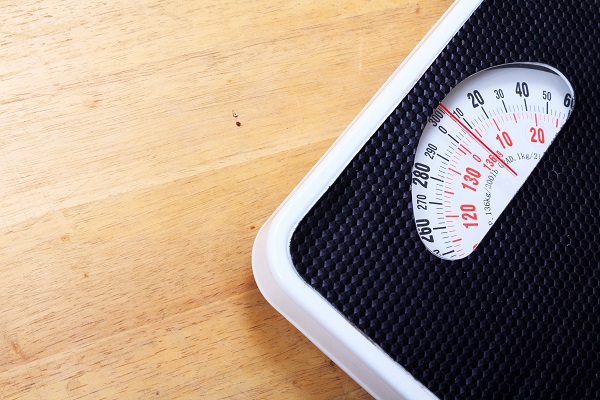
Based on Newton's First Law, we know that the tendency of an object to resist motion is called its inertia. Every object has inertia and it solely depends on the object's mass. Mass is a measure of the object's tendency to resist motion, but it is also a measure of how much matter is in that object. In other words, the more matter an object contains, the more inertia it has.
Most of us believe that mass and weight are the same thing, but that is because they are directly proportional to one another. We only have reference on Earth to how heavy an object feels, and that gives us an idea of how massive the object is as well. We are used to measuring mass based on the pull that the Earth has on the object. Mass, though, is more fundamental than weight—it is independent of its location. The mass of the object on Earth is going to be the same as the mass on the Moon or any other planet.
Did you know that your weight might be slightly different at different elevations? It's true, but it is probably not different enough to register on most scales used today to measure weight. Your weight will be different on the Moon. So, what does that make weight? Weight is a measure of the gravitational force on the object. You'll learn more about what affects gravity later, but essentially, the more massive a planet is, the more gravitational pull it has. That's why the force of gravity on the Moon is only about \(\small\mathsf{ \frac{1}{6} }\) of that of the Earth. You can find the weight of an object by simply multiplying the mass of the object by the acceleration of gravity.
Weight
\(\large\mathsf{ \overrightarrow{W} = m \overrightarrow{g} }\)
Knowing this, you can determine the force of gravity on an object if you know its mass. You will notice that weight is measured in Newtons which is the same as \(\small\mathsf{ \text{ kg} \cdot \text{ m/s}^2 }\).
Question
What is the force of gravity (on Earth) on an object with a mass of 5.5 kg?
The weight would be \(\small\mathsf{ \overrightarrow{W} = (5.5 \text{ kg})(9.81 \text{ m/s}^2) = 54 \text{ N} }\).
