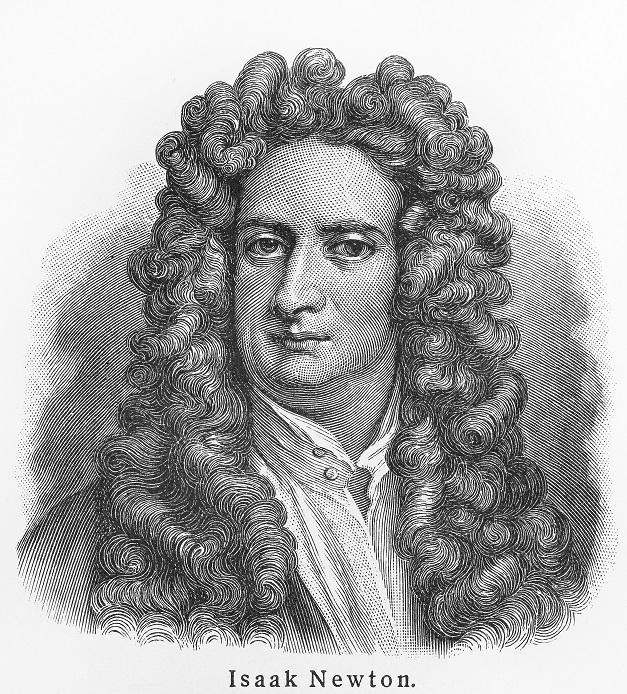
Scientists take information that is known before and refine it based on new evidence. That's exactly what Newton did. In fact, the ideas that defined motion were first introduced by Aristotle, some 2000 year before Newton's time. The scientific thought that time was that a force was necessary to keep an object in motion. That idea was completely turned on its head when Galileo first introduced the concept of inertia. Galileo was the first to state that the absence of a force is what kept an object from changes in motion. Newton then refined that idea when he developed his laws of motion, in fact Newton's first law is also known as the law of inertia.
Newton's First Law—The Law of Inertia
An object at rest will stay at rest and an object in motion will stay in motion unless acted upon by an unbalanced force.
With kinematics, we can describe the motion of an object. With Newton's laws of motion, we can predict what the motion will be if we understand the forces acting on the object. Newton's First Law tells us that with the presence of an unbalanced force, there will be acceleration. Newton's Second Law will help us determine how much that acceleration will be.
Question
What must be true about Newton's ideas for them to be considered laws?
These laws are accepted as true because there has been no contradictory evidence found and there is general agreement among scientists. They have been around since 1627 and have withstood centuries of scientific challenges.
