Before we compare the horizontal and vertical methods, let's go through two more examples.
Problem 1
Problem 2
Multiply
(x + 2)(x\(\small\mathsf{ ^2 }\) + x + 3)
using the vertical method. Then click below to check your work.
SOLUTION:
| x\(\small\mathsf{ ^2 }\) | + x | + 3 | |
| x | + 2 | ||
| 2x\(\small\mathsf{ ^2 }\) | + 2x | +6 | |
| x\(\small\mathsf{ ^3 }\) | + x\(\small\mathsf{ ^2 }\) | + 3x | |
| x\(\small\mathsf{ ^3 }\) | + 3x\(\small\mathsf{ ^2 }\) | + 5x | + 6 |
| A truck will be loaded with boxes that are 3x\(\small\mathsf{ ^2 }\) + 4x – 5 centimeters long and 7x\(\small\mathsf{ ^2 }\) + 8x – 6 centimeters wide. Use the vertical multiplication method to calculate the polynomial that represents the area taken up by one box. | 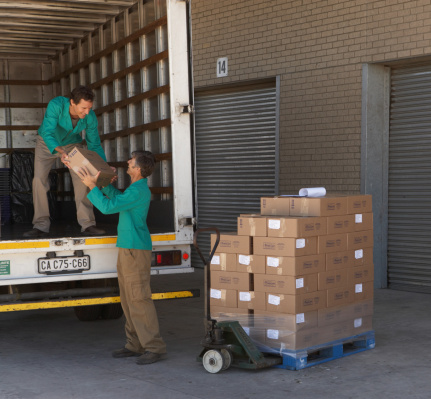 |
SOLUTION:
| 3x\(\small\mathsf{ ^2 }\) | + 4x | – 5 | ||
| 7x\(\small\mathsf{ ^2 }\) | + 8x | – 6 | ||
| –18x\(\small\mathsf{ ^2 }\) | – 24x | + 30 | ||
| 24x\(\small\mathsf{ ^3 }\) | + 32x\(\small\mathsf{ ^2 }\) | – 40x | ||
| 21x\(\small\mathsf{ ^4 }\) | + 28x\(\small\mathsf{ ^3 }\) | – 35x\(\small\mathsf{ ^2 }\) | ||
| 21x\(\small\mathsf{ ^4 }\) | + 52x\(\small\mathsf{ ^3 }\) | – 21x\(\small\mathsf{ ^2 }\) | – 64x | + 30 |
