A hammer, a set of pliers, scissors, a wheel barrow, a nut cracker, and a human arm are all examples of a lever. The lever either changes the direction of the applied force or the magnitude of the applied force or both. There are actually three different classes of levers, depending on where the load force, the effort force, and the fulcrum are in relation to one another. Study the image below to see the difference.
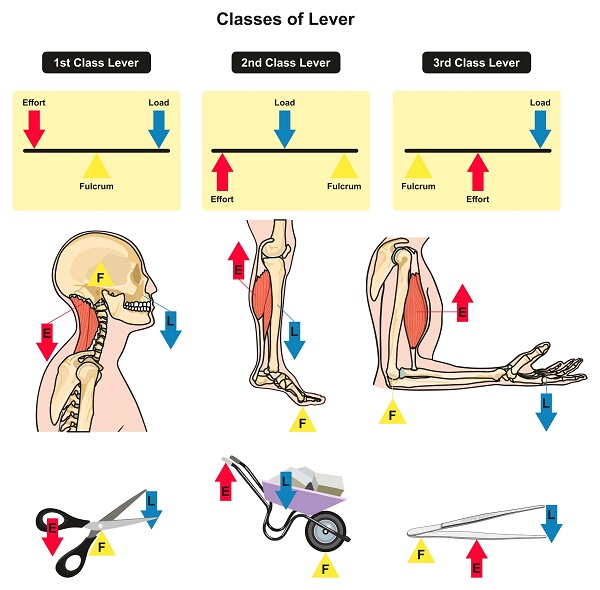
After studying the three classes of levers, try to determine which type each of these examples would be using the interactive below. Drawing a picture to locate the fulcrum, the load force, and the effort force will help you figure out the class of lever.
Opening a car door.
The fulcrum is at the end, then the load is in the middle, and the effort force is on the outside.
The fulcrum is at the end, then the load is in the middle, and the effort force is on the outside.
The fulcrum is at the end, then the load is in the middle, and the effort force is on the outside.
Pulling in a fish using a fishing rod.
The fulcrum is at the near end, then the effort force, then the load force.
The fulcrum is at the near end, then the effort force, then the load force.
The fulcrum is at the near end, then the effort force, then the load force.
Using a screwdriver to open a paint can lid.
The load is at the end, then the fulcrum is in the middle, and then the effort force.
The load is at the end, then the fulcrum is in the middle, and then the effort force.
The load is at the end, then the fulcrum is in the middle, and then the effort force.
Sweeping the floor with a broom.
The fulcrum is at the very top (top hand), then the effort force (middle hand), then the load force (or resistance of friction on the floor).
The fulcrum is at the very top (top hand), then the effort force (middle hand), then the load force (or resistance of friction on the floor).
The fulcrum is at the very top (top hand), then the effort force (middle hand), then the load force (or resistance of friction on the floor).
Cracking a nut with a nutcracker.
The fulcrum is at the top, then the load force, then the effort force is near the bottom.
The fulcrum is at the top, then the load force, then the effort force is near the bottom.
The fulcrum is at the top, then the load force, then the effort force is near the bottom.
Hitting a ball with a tennis racket.
The fulcrum is between the effort force and the load force.
The fulcrum is between the effort force and the load force.
The fulcrum is between the effort force and the load force.
Using a hammer to pry up a nail.
The fulcrum is between the effort force and the load force.
The fulcrum is between the effort force and the load force.
The fulcrum is between the effort force and the load force.
Doing a push-up on your hands in plank position.
Your feet serve as the fulcrum, your body is the load force, and your arms are the effort force.
Your feet serve as the fulcrum, your body is the load force, and your arms are the effort force.
Your feet serve as the fulcrum, your body is the load force, and your arms are the effort force.
You got # out of # correct. Click the Retry button for another attempt.
You got a perfect score. Great job!
