Primary and secondary succession both begin with a disturbance to a plant community. The disturbance initiates the process of succession. As the process of either type of succession continues, changes in the vegetation of the area occur over time.
The changes in the vegetation that occur during succession are influenced and driven by the biotic and abiotic factors of the community. Read each tab to find out what these are.
Allogenic Factors
Autogenic Factors
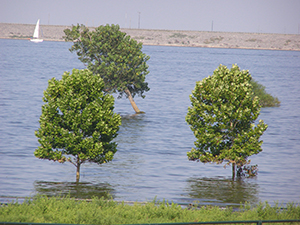 Allogenic factors are due to the abiotic components of the ecosystem. Examples of allogenic factors include soil changes due to erosion, sediments collecting in a marsh, climate change, even periodic fires or floods.The allogenic factors influence and drive the growth of the vegetation in a given area.
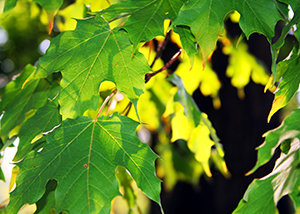 Autogenic factors are due to the plants themselves. Autogenic factors include leaves capturing light (as seen in this image), production of detritus (bodies of dead organisms and fecal material), uptake of water and nutrients, and fixation of nitrogen. These factors can make the community more or less suitable for certain plant species. For example, when large trees mature, they cause shade that blocks out the sun. As a result, forms of vegetation that require lots of sunlight will not be able to grow, but other forms of vegetation that can grow in the shade will invade the area.
Test your understanding of the factors that influence and drive succession by dragging the example to the correct term.
Meteor
|
Allogenic Factor
Autogenic Factor
|
|
Nutrient Uptake
|
Allogenic Factor
Autogenic Factor
|
|
Earthquake
|
Allogenic Factor
Autogenic Factor
|
|
Flooding
|
Allogenic Factor
Autogenic Factor
|
|
Detritus
|
Allogenic Factor
Autogenic Factor
|
Complete
