There was another motive behind Andrew Jackson's approach to "Indian affairs" as well—besides a desire to make tribal lands free for settlement by farmers and plantation owners. While earlier presidents had urged the tribes to assimilate into white American society, Jackson believed that Indian tribes were sovereign nations that would never be fully willing to follow American laws and customs. He argued that moving the tribes west of the Mississippi would both force and allow them to settle permanently on new lands, where they might live as they pleased.
How far did Jackson expect Native Americans to move? Study the map below closely.
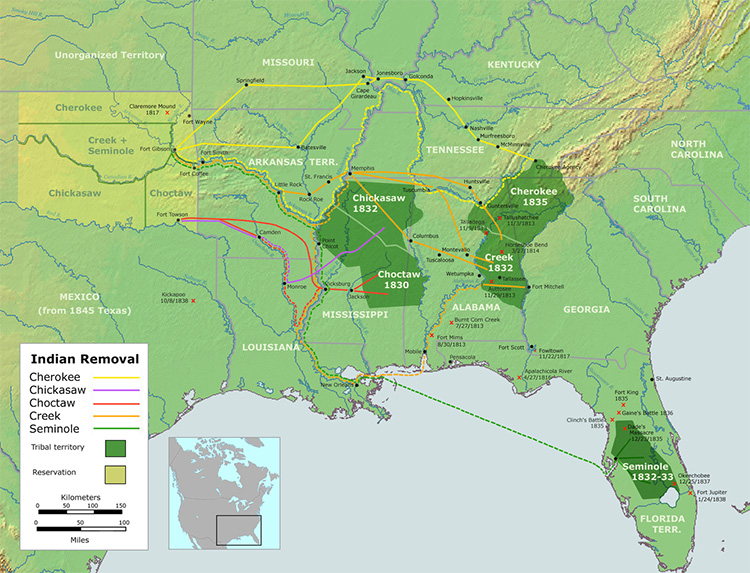 |
| The original homelands of the Five Civilized Tribes, and their routes to Indian Territory in modern-day Oklahoma. |
Use the questions below to examine the geographical realities of Indian Removal.
|
Which of the Five Civilized tribes had to travel the farthest to reach Indian Territory?
|
Seminoles
Choctaw
Cherokee
|
The Seminoles were expected to leave a climate and landscape that was very different from anything in Indian Territory—it was the difference between Florida and Oklahoma.
The Seminoles were expected to leave a climate and landscape that was very different from anything in Indian Territory—it was the difference between Florida and Oklahoma.
|
Which Native American group had the shortest distance to travel to Indian Territory?
|
Creek
Cherokee
Chickasaw
|
The Chickasaw offered little resistance to removal, perhaps in part because they had less distance to move. They also were awarded the largest parcel of tribal land among the Five Civilized Tribes.
The Chickasaw offered little resistance to removal, perhaps in part because they had less distance to move. They also were awarded the largest parcel of tribal land among the Five Civilized Tribes.
|
Which Native American tribe had to cross the Appalachian Mountains to reach Indian Territory?
|
Seminole
Cherokee
Choctaw
|
The Cherokee resisted removal for a long time. When they were finally forced to leave their ancestral lands, most had to walk across the mountains and were allowed meager supplies for the trip.
The Cherokee resisted removal for a long time. When they were finally forced to leave their ancestral lands, most had to walk across the mountains and were allowed meager supplies for the trip.
Complete
