Thanks to the efforts of public figures like Pearl S. Buck and Dale Evans Rogers, the Americans with Disabilities Act (ADA) and the Individuals with Disabilities Education Act (IDEA) were passed in 1990, bending the moral arc a tiny bit closer to justice. These laws protect people from discrimination on the basis of disability, and help ensure that disabled people have access to the same employment and educational opportunities as everyone else.

To see how laws like the ADA look and work in the real world, let's turn to a different kind of informational text: official government documents. We'll read part of the Americans with Disabilities Act itself, and we'll examine a page from the White House's website about the Act's 25th anniversary. As you read these documents, consider what audiences each document addresses, what purpose it is meant to serve, and how the two documents differ in form, structure, and style.
First, here's an excerpt from the actual text of the Americans with Disabilities Act of 1990.
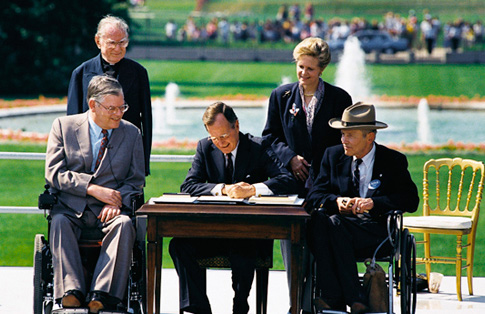
Americans with Disabilities Act
Sec. 12101. Findings and purpose
(b) Purpose
It is the purpose of this chapter
(1) to provide a clear and comprehensive national mandate for the elimination of discrimination against individuals with disabilities;
(2) to provide clear, strong, consistent, enforceable standards addressing discrimination against individuals with disabilities;
(3) to ensure that the Federal Government plays a central role in enforcing the standards established in this chapter on behalf of individuals with disabilities; and
(4) to invoke the sweep of congressional authority, including the power to enforce the fourteenth amendment and to regulate commerce, in order to address the major areas of discrimination faced day-to-day by people with disabilities.
And here is a video showing President Obama celebrating the 25th anniversary of the ADA with disabled Americans at the White House.
What basic similarities and differences do you notice between these two informational documents? Use the activity below to sort the features of each into the correct basket. Then check your answers to see how you did.
| ADA Text | ADA Anniversary Video |
Both |
|
|
|
|
|
formal
specific audience
cultural change
stated purpose
informal
general audience
governmental
civil rights focus
less structured
highly structured
informational
implied purpose
|
||
You got them all!
