How would you define a significant moment or event--what makes a person, event, or idea memorable? A truly impactful moment in your life is a moment that "impacts" or changes you. Sometimes these moments are large, and the significance is immediately known: a personal tragedy, a move, the birth of a sibling, or a natural disaster. Other times, these moments are smaller, and their effects not obvious to you until years later. These moments are important not because of the facts or the details but because of our interpretations of the events.
While no two people have the same significant events, every generation experiences a major event (or events) that impact them; such as a war, natural disaster, or a moment like 9/11. A historical narrative is written when you take these moments and add your unique voice and perspective.
For the generation that came of age during the 1860s, the passage of the Homestead Act was one such event. It gave 160 acres of land to any citizen in exchange for a small fee and 5 years of continuous residency on the land. As you might imagine, the Homestead Act contributed significantly to the westward expansion, and this was its purpose, in fact. After losing her husband and trying to support herself and her daughter, Jerrine, Elinore Pruitt Stewart moved to Wyoming and filed a claim for herself. Writing letters to her former boss about her experiences on her new land, Elinore created a historical narrative that would help historians and other readers understand how the western U.S. was settled and what kinds of lives the pioneers of the 1800s lived.
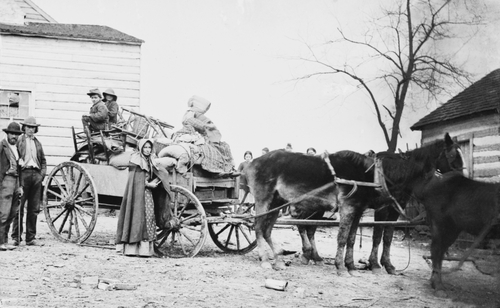
Read the following letter from Letters of a Woman Homesteader. As you read think about what these letters reveal about life on a homestead in the early 1900s and answer the questions that go along with the passage.
What does this passage show about Stewart’s view of homesteading?
Does her view of homesteading match what you know about the “Wild West” and Frontier life?
How does her letter create a historical understanding of life at that time?
| Your Responses | Sample Answers |
|---|---|
| She views it as the answer to poverty and woman’s struggles. She feels any woman who is struggling financially should apply for a homestead as to establish independence and financial security. | |
| Your reading and frontier life probably revealed that it could be difficult and challenging and that homesteaders faced many hardships. Stewart downplays the difficulties and paints only the positive aspects of life. | |
| Through her letter, the reader can see the challenges that women and others faced at that time. It is clear that many individuals struggled with poverty and their limited opportunities for women. She also shows how Americans have always viewed the movement West as the start of a new life and the prospect for wealth and security. | |
January 23, 1913
Dear Mrs. Coney,—
I am afraid all my friends think I am very forgetful and that you think I am ungrateful as well, but I am going to plead not guilty. Right after Christmas Mr. Stewart came down with la grippe and was so miserable that it kept me busy trying to relieve him. Out here where we can get no physician we have to dope ourselves, so that I had to be housekeeper, nurse, doctor, and general overseer. That explains my long silence.
And now I want to thank you for your kind thought in prolonging our Christmas. The magazines were much appreciated. They relieved some weary night-watches, and the box did Jerrine more good than the medicine I was having to give her for la grippe. She was content to stay in bed and enjoy the contents of her box.
When I read about the hard times of the Denver poor, I feel like urging them, every one, to get out and file on land. I am very enthusiastic about woman homesteading. It really requires less strength and labor to raise plenty to satisfy a large family than it does to go out and wash, with the added satisfaction of knowing that their job will not be lost to them if they care to keep it.
Even if improving the place does go slowly, it is that much done to stay done. Whatever is raised is the homesteader’s own, and there is no house-rent to pay. This year Jerrine cut and dropped enough potatoes to raise a ton of fine potatoes. She wanted to try, so we let her, and you will remember that she is but six years old. We had a man to break the ground and cover the potatoes for her and the man irrigated them once. That was all that was done until digging time, when they were ploughed out and Jerrine picked them up. Any woman strong enough to go out by the day could have done every bit of the work and put in two or three times that much, and it would have been so much more pleasant than to work so hard in the city and then be on starvation rations in the winter.
To me, homesteading is the solution to all poverty’s problems, but I realize that temperament has much to do with the success in any undertaking, and persons afraid of coyotes and work and loneliness had better let ranching alone. At the same time, any woman who can stand her own company, can see the beauty of the sunset, loves growing things, and is willing to put in as much time at careful labor as she does over the washtub, will certainly succeed; will have independence, plenty to eat all the time, and a home of her own in the end.
Experimenting need cost the homesteader no more than work, because by applying to the Department of Agriculture at Washington he can get enough of any seed and as many kinds as he wants to make a thorough trial, and it doesn’t even cost postage...I want to be able to speak from experience when I tell others what they can do. Theories are very beautiful, but facts are what must be had, and what I intend to give some time.
