Sometimes English can be a frustrating language. Spellings don't always make sense, and there's a lot to learn about how to put clear sentences together. But one advantage English has over some languages is its huge vocabulary. So many words, so many meanings—and many times, the same word has several meanings.



Consider the word coat. So short, so simple . . . yet it can mean many things. As a noun, it can mean a heavy garment you wear to stay warm, an animal's fur, or a layer of something—say, a coat of paint. As a verb, it can mean to cover or enclose, as when ice coats the roads or chocolate wraps around caramel. And this list doesn't even cover all the meanings of coat.
Poets rely on multiple-meaning words to help them build layers of meaning into their poems. Your job, as a reader, is to consider both—or all—of a word's meanings and then use those meanings to understand the poem more completely. American poet Langston Hughes published this poem in 1921, but it reaches much further back into history. The first time you read and listen to "The Negro Speaks of Rivers," just capture the ideas. The read the poem again, paying attention to the word choice. See if you can find all of the words that could mean more than one thing in the poem's context.
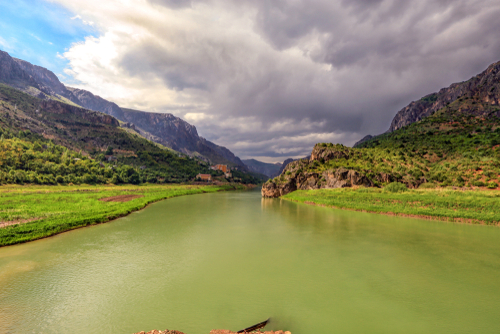
The Euphrates flows through Syria and Iraq to join the Tigris in the Shatt al-Arab, which empties into the Persian Gulf.
The Negro Speaks of Rivers
I've known rivers:
I've known rivers ancient as the world and older than the flow of human blood in human veins.
My soul has grown deep like the rivers.
I bathed in the Euphrates when dawns were young.
I built my hut near the Congo and it lulled me to sleep.
I looked upon the Nile and raised the pyramids above it.
I heard the singing of the Mississippi when Abe Lincoln went down to New Orleans, and I've seen its
muddy bosom turn all golden in the sunset.
I've known rivers:
Ancient, dusky rivers.
My soul has grown deep like the rivers.
Langston Hughes
Did you notice any multiple-meaning words in the poem? The questions below can help you get started in finding them—and thinking more deeply about what they mean. Try to answer each question on your own. Then click the question to see a sample answer.
Dawn has a literal meaning. It's a synonym for sunrise, a time of day. Dawn also has less literal meanings that refer to "the beginning of something" or "the earliest phase of something," like the dawn of an idea. |
|
In this line, dawn is the literal time of day when the speaker bathed in the river, but it's also the beginning of something large and important. Dawn is personified as something that can be "young" and then grow toward maturity. Because the Euphrates was one of the first rivers where people settled to build towns, perhaps it's like the dawn of civilization. The speaker was there, at that pivotal moment when civilization was just beginning to grow. |
