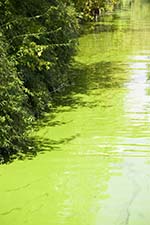
 A good way to come up with a scientific question is to identify a knowledge gap. Think of something you are curious about, learn what we already know about it, and make a list of what we don't know about it. The things that we don't yet know will lead you to a new question. For example, take a look at the photograph on the right of severe water pollution.Then, click the column headings in the chart below to see what scientists do and do not yet know about water pollution.
Anywhere there is a knowledge gap (something scientists don't yet know) you could formulate a new question that will lead to a new scientific investigation.
| What Scientists Know |
What Scientists Don't Yet Know |
| The pollution is caused by microscopic algae that live in the water. |
How do severe storms like hurricanes affect the algae that cause this pollution? |
| This pollution is found in both fresh water and ocean water. |
How do human activities affect the algae? Can human activities make the algae grow faster and thus make the pollution worse? |
| There are several types of algae, and each type has a different effect on the water. |
Why are some types of algae more harmful to the water than others? |
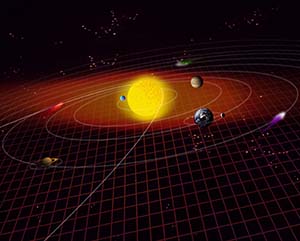
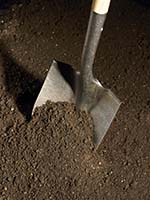 Remember that a scientific question needs to be one that can be answered by the materials you have access to. It would be great, for example, to investigate what the surface soil of a planet in another solar system is like. But we don't currently have the technology to send spacecraft outside of our solar system, so we wouldn't be able to collect evidence to answer that question. You do however, have many tools on hand that can help you learn about the soil in your own backyard.
Scientific questions don't have to answer everything all at once. Often scientific discovery comes in small chunks at a time. For example, people have been curious about the universe for thousands of years, but our understanding of how the universe formed and what it is made of has come through hundreds and hundreds of scientific investigations over many years, and not all at once. In your own investigations, ask questions that can be answered in reasonable amounts of time based on the resources you have at hand. Then, after you answer one question, move on to the next--each new question can build on the previous one. You might, for example, first investigate the types of rocks in one part of your state before you try to investigate every rock type in the United States.
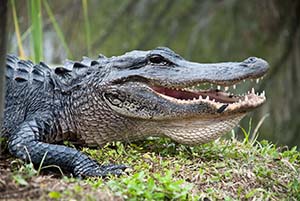
It's okay if you need to change or fine-tune your question once you start an experiment or investigation. Sometimes your experiment will help you see new questions or view things in a different light. For example, suppose you ask "How does temperature affect the number of eggs that a female alligator lays?" Then you go out and start counting eggs in alligator nests in places with different temperatures. Along the way you notice that there is no difference based on temperature but that there does seem to be a difference based on the size of the mother alligator. You could then refine your question to ask "How does the size of the mother alligator affect the number of eggs she lays?" (You should also know to stay as far away as possible from mother alligators!)