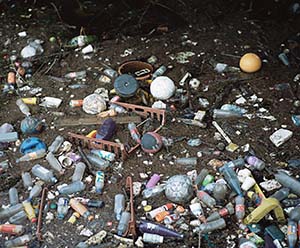
 Suppose you have just learned that contamination from plastic materials can harm some living organisms. You then ask yourself "How many organisms on Earth are harmed by plastics?" While you could theoretically test this by checking every living thing on Earth, it is very improbable that you would really be able to carry out such a large task. Thus, this question is theoretically testable, but it is too broad to be of much use. A common pitfall when asking scientific questions is to ask a question like this that is too broad and not more specific. You will have greater success as a scientist if you learn to ask specific questions.
Question
How could you reword the question above to make it more specific?
The question could be reworded to "What is the effect of plastics contamination on fish in rivers near Chicago?" or "How does plastics contamination affect insects in freshwater lakes?" By making the question more specific, you are more likely to have success when you attempt to answer it.
 Another common pitfall is asking questions that are too narrow. For example, suppose you ask "How many fish are in Fishhawk Creek?" This is an objective and testable question, but just knowing the number of fish in the creek doesn't tell us much. Why do you want to know the number of fish in the creek? In this case, you could reword the question to say "How does the number of fish in the Fishhawk Creek affect the number of eagle nests near the creek?"
Since eagles hunt for and eat fish, it is now more obvious why you would be concerned about how many fish are in the creek. The new question is also better suited for developing new scientific knowledge. It will tell us something about the relationship between fish and eagles, whereas the original question about the number of fish only did not tell us anything about relationships.
There's one more pitfall you will want to avoid. See if you can find it in the question below.
Question
Is this a good scientific question: Is organic fertilizer better than non-organic (man-made) fertilizer?
At first glance, this looks like a good question because it seems testable. But what is meant by "better?" Is a fertilizer better because it makes plants grow bigger? Is it better because it causes less environmental contamination? Without defining what is meant by "better," it's hard to test and answer this question. You could reword it to something like "How does organic fertilizer affect the growth of tomatoes when compared to non-organic fertilizer?"
