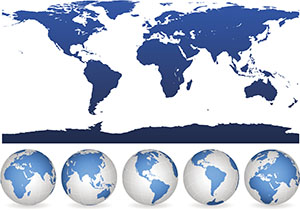
 Another way to develop your skill for asking testable questions is to recognize the difference between scientific and non-scientific questions. A scientific question is one that can be answered by experimenting, investigating, exploring, and collecting data. For example, suppose you look at the picture of the Earth's continents shown here and wonder why the east coast of South America and the west coast of Africa look like they could fit together like pieces of jigsaw puzzle. Out of curiosity, you begin to wonder if the two land masses were ever connected as one, and you ask "What mechanism could explain how the two continents got broken apart?" That is a scientific question that can be answered by exploring the features of the two continents, learning about the ocean floor in between them, and conducting experiments to see what types of motion could have accomplished something as big as moving Earth's land masses apart. With each part of your inquiry, you'll learn more and more until you come to a possible answer.
Non-scientific questions, on the other hand, do not need to be or cannot be answered through systematic investigations. They often are based on beliefs, opinions, or feelings instead of objective observations. "Who is the best music star of all time?" is an example of a non-scientific question. Other non-scientific questions require little investigation to answer, such as "What is the closest ice cream shop to my house?"
In scientific inquiry, it is important to conduct investigations that will provide evidence as to how something works or why it functions the way it does. Scientific questions will lead to experiments that will provide evidence. They will be testable. Non-scientific questions do not lead to experiments as a way of learning or knowing.
Earth Jigsaw.
Many early scientists wondered why the continents look like jigsaw puzzle pieces. By exploring the ocean floor, scientists have learned that Earth's land masses were once connected, and that they are moving apart because of a long "spreading center" in the floor of the Atlantic Ocean--a place where the ocean floor is opening up and pushing outward in opposite directions.
