Why do scientists believe we share a direct common ancestor with apes? And how do they know that before humans existed, human-like beings lived on the earth? Well, the evidence is out there and supports the idea that humans evolved from a common ancestor shared with apes.
Click through these tabs to see the types of evidence that support how humans evolved into what they are today.
Morphological Evidence
Molecular Evidence
Other Evidence
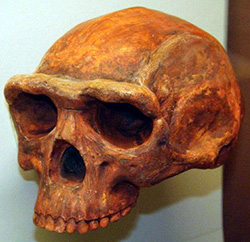 From a few teeth to complete skeletons, scientists have uncovered more than 6,000 individuals hominid fossils. These fossils enable researchers to study changes that occurred in brain and body size, locomotion, diet, and other aspects regarding the way of life for early human species. The image shows a skull of one of our distant relatives, Homo erectus.
Other than the structure of the leg bones, scientists can tell if a hominid walked upright. They use the location of the foramen magnum (hole at the base of skull where spinal cord exits) to determine if the hominid walked more upright or more hunched over like an ape.
The layers of rock that contain fossils can be dated by many different techniques. Some techniques can even directly estimate the age of the bones and teeth. Advances in dating have made the study of human evolution very exciting.
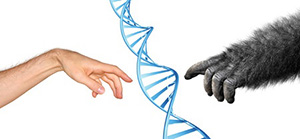 Recall that scientists are able to compare evidence of evolution at the molecular level. Our genetics provide evidence of how closely we are related to one another and to all other species. This evidence can indicate the prehistoric migrations of our species all over the world. By using molecular clocks, it can be determined that we are very closely related to apes and diverged into separate species from a common ancestor.
What do scientists compare at the molecular level to determine evolutionary relationships?
The base sequences in DNA and amino acid sequences in proteins are used for comparisons.
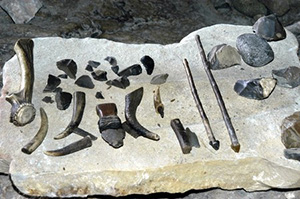 Millions of stone tools (like the ones pictured above), figurines, cave paintings, footprints, and other traces of humans in the prehistoric record tell about where and how early humans lived. This evidence also gives us clues as to when certain technological innovations were invented.
Aspects of the environment that early humans lived in can be determined by studying footprints. What types of human behaviors may be assumed by studying various footprints?
If a group of footprints from different individuals are found, it is assumed this group lived in a social situation.
Question
What can dating and the fossil record tell us about the big picture of human evolution?
