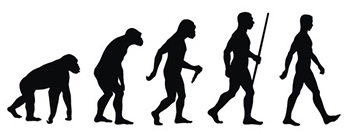
Humans are hominids that are classified into the genus Homo. What are some characteristics that humans share, even the very first humans? Recall that various types of evidence exist to show how humans evolved over time. Hominid fossils, tools, and cave paintings tell a story about how early humans lived. Based on this evidence, we see that several human characteristics evolved over the past 6 million years. These traits did not emerge all at once or in any one species. Check out this slideshow to learn about the evolution of important human characteristics.
Walked Upright
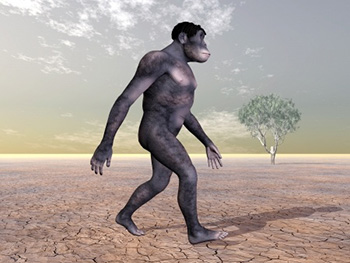
The earliest humans climbed trees and walked on the ground. The ability to walk upright on two feet is called bipedalism. Scientists can study the structure of the leg bones and the location of the foramen magnum to determine this characteristic. How do you think this flexibility helped these early humans?
It helped them get around in diverse habitats and cope with changing climate.
Used Tools to Get Food
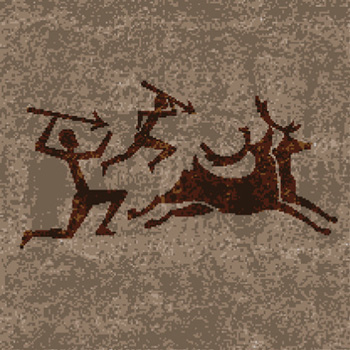
Early humans butchered large animals at least 2.6 million years ago. By at least 500,000 years ago, humans made wooden spears to hunt large animals. What evidence exists to prove this characteristic?
Cave paintings and tools found with human and animal remains are evidence.
Adaptive Human Body Shape
Human body shapes vary, but all humans have a sturdier pelvis and longer legs compared to apes, which have longer arms. As early humans spread to different environments, their body shapes changed to help them survive in hot and cold climates. Changing diets also led to changes in body shape. For example short, wide bodies, like the one pictured above, are adapted more to colder climates because they conserve heat better. What do you think the bodies of the early humans in southern Africa were like?
Considering the climate there is hot and dry, taller and leaner bodies are more adapted to this area.
Large, Complex Brains
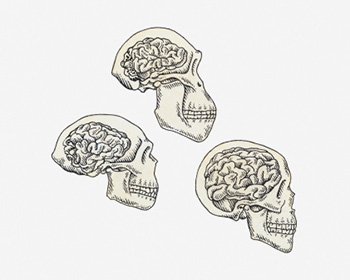
As early humans faced new environmental challenges and evolved bigger bodies, they evolved larger and more complex brains. By comparing the three images above, which represents Homo sapiens, our species?
The skull on the far right represents Homo sapiens. Notice it has the largest brain.
Social Life
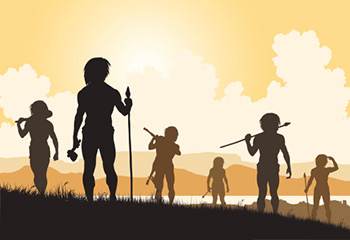
Sharing food, caring for infants, and building social networks helped our ancestors meet the daily challenges of their environments. Use of Symbols
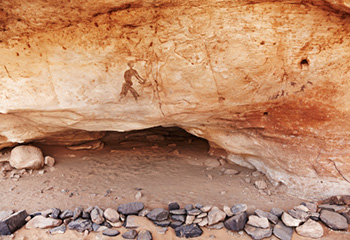
Symbols (shown in this ancient cave) changed the way humans lived and provided new ways to cope with an unpredictable world. |
 |

 Macchu Picchu, an ancient city in Peru. |
Question
Which human characteristic do you think evolved first, large brain size or the use of symbols?
