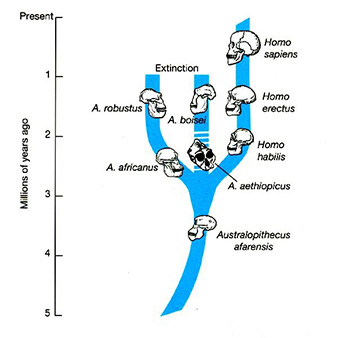
 Possible Hominid Family Tree |
Now that we have established the evidence of how early humans lived, let's take the journey and find out the steps in the evolution of Homo sapiens, which is our species. How did we become the humans we are today? Remember that we share a common ancestor with apes. Scientists believe this common ancestor existed over 5-6 million years ago. Shortly thereafter, the species diverged into two separate lineages. One of these lineages ultimately evolved into gorillas and chimps, and the other evolved into early human ancestors called hominids. This evolutionary family tree illustrates the lineage that ultimately evolved into Homo sapiens.
By using this family tree, which hominid did Homo sapiens directly evolve from?
They came from Australopithecus afarensis.
Although Homo sapiens is the only surviving human species, we are part of a large human family tree. Not all members of our ancient family are shown in the illustration above. The fossil record has so far revealed evidence for more than 20 species of ancient human relatives (hominids). We know about some of our early relatives because of fossil evidence, and our understanding of our family tree grows as new fossils are revealed. The locations of these fossils also show that some humans began to migrate, or move, out of Africa. Human fossils possessing physical features, such as elongated legs adapted to walking to long distances, were found all the way up in Europe and Asia.
The table below outlines some of the important members of our ancient hominid family as they progressed over 4 million years ago from early hominid to Homo sapiens.
| Australopithecus | Various species of this early hominid, including Australopithecus afarensis, lived from 4.2-2 million years ago. Members had both ape-like and human characteristics with smaller brains and projecting lower jaws. They lived in Africa. |
| Homo habilis | This species, one of the earliest members of the genus Homo, lived 2.4-1.4 million years ago. It has a slightly larger brain case and smaller face and teeth than in Australopithecus or older hominid species. But it still retains some ape-like features, including long arms and a moderately protruding face. The name means "handy man," referring to its use of stone tools. |
| Homo erectus | This early human lived between 1.89 million and 143,000 years ago. Early African Homo erectus fossils (sometimes called Homo ergaster) possessed modern human-like body proportions with relatively elongated legs and shorter arms compared to the size of the torso. These features are considered adaptations to a life lived on the ground and the ability to run long distances. This species was the first to migrate out of Africa into Europe and Asia. |
| Homo neanderthalensis | This early human is referred to as Neanderthal man. He lived in Europe 200,000 to 40,000 years ago. Neanderthals are our closest extinct human relative. They were stockier and shorter than us, but their brains were almost as large. They made and used sophisticated tools, used fire, lived in shelters, and buried the dead. |
| Homo sapiens | Modern humans replaced the European Neanderthals about 34,000 year ago. These first Homo sapiens are referred to as Cro-Magnons. Most scientists believe these modern, more sophisticated humans out-competed the Neanderthals for resources and drove them to extinction. However, some believe the Cro-Magnon and Neanderthals actually interbred, resulting in humans containing some Neanderthal DNA. Even though they are now extinct, Cro-Magnons had complex social organizations, modern language capabilities, and lived by hunting. These humans spread across Siberia to North America. By about 12,500 years ago, humans had reached all the way down to South America. |
Question
According to this hominid family tree, which species is designated as the first "human"?
