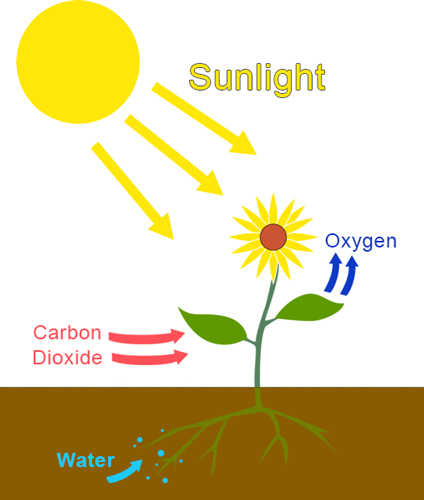
Most plants, algae, and cyanobacteria can perform photosynthesis--the process by which cells turn the Sun's light into energy we can all use. But exactly what happens during photosynthesis? First, look at this basic diagram of the process.
 By At09kg (Own work) [CC-BY-SA-3.0 (http://creativecommons.org/licenses/by-sa/3.0)], via Wikimedia Commons |
As the diagram shows, plants use carbon dioxide and water, mainly from the soil, to perform photosynthesis. The process is fueled by energy from the Sun (radiation) and produces oxygen gas (O2). The chemical equation below shows a more technical, scientific version of photosynthesis as a process. Read the equation carefully. Then see if you can answer the question below.

Question
Why is glucose shown in the equation but not represented in the diagram?
The diagram is showing materials the plant takes in from the environment and releases as a result of photosynthesis. Glucose is also made by photosynthesis but it is kept by the plant cells to provide energy for other cellular processes.
