Some reactions proceed in only one direction (from reactants to products) until they reach completion. However, many reactions are reversible, meaning they can proceed in both the forward and reverse directions. In a chemical equation for a reversible reaction, the reactants and products are separated by a double arrow, as shown in this image.
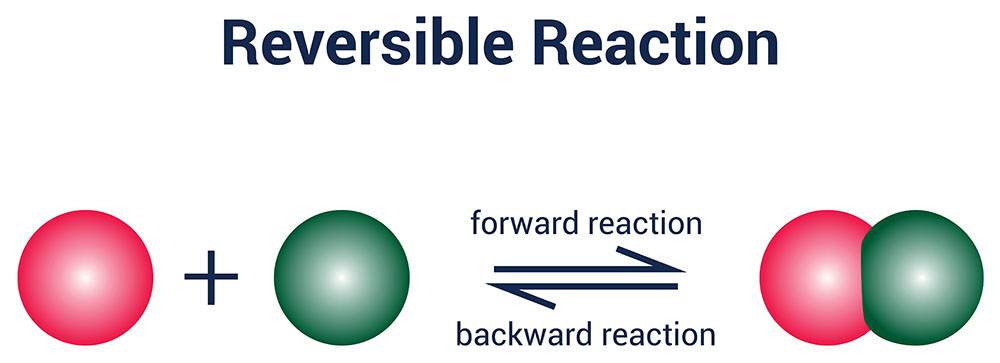
In a reversible reaction, some of the reactants turn into products, while some of the products simultaneously turn back into reactants. When both the forward and reverse reactions are occurring at the same rate, we say that the reaction has reached chemical equilibrium. After this point, the concentrations of the reactants and products do not change. However, chemical reactions that are in equilibrium can be disrupted to produce more reactants or more products. This can happen due to a change in concentration, as described below.
| increasing the concentration of a substance | A reaction can be disrupted by adding more of one of the substances. The reaction will shift away from the added substance so it can use up the extra chemical and get back to equilibrium. |
| decrease the concentration of a substance | A reaction can also be disrupted by removing one of the substances. In this case, the reaction will shift towards the removed substance so it can make more of the missing chemical to reach equilibrium again. |
For example, when baking soda is dissolved in water, it decomposes into carbon dioxide gas (CO2) and sodium hydroxide (NaOH), which stays dissolved in the water.
\( \displaystyle NaHCO_{3} \leftrightarrow CO_{2} + NaOH \)
Click each stress in this table to see how adding or removing different substances affects the equilibrium of the reaction above.
| Add \( NaHCO_{3} \) | More reactants were added, so the reaction will shift to make more products until it can reach equilibrium. |
| Add \( {{CO}}_{2} \) | More products were added, so the reaction will shift to make more reactants until it can reach equilibrium. |
| Add \( {{NaOH}} \) | More products were added, so the reaction will shift to make more reactants until it can reach equilibrium. |
| Remove \( NaHCO_{3} \) | Reactants were removed, so the reaction will shift to make more reactants until it can reach equilibrium. |
| Remove \( {{CO}}_{2} \) | Products were removed, so the reaction will shift to make more products until it can reach equilibrium. |
| Remove \( {{NaOH}} \) | Products were removed, so the reaction will shift to make more products until it can reach equilibrium. |
Question
When water undergoes electrolysis, it decomposes into its component gases, hydrogen, and oxygen, according to this equation:
\( \displaystyle {H}_{2}{{O}} \leftrightarrow {H}_{2} + {O}_{2} \)
What are two ways to produce increased amounts of H2 at equilibrium?
1. Add more water (H2O). If more water is added to the system, the reaction will shift to make more products until it can reach equilibrium.
2. Decrease the concentration of oxygen (O2). If the concentration of oxygen decreases, the equilibrium will shift to make more products to make up for the deficit.
