How did you feel after reading the decision in Plessy v. Ferguson? Angry? Outraged? Confused? Supreme Court decisions often involve controversial issues--racial discrimination, abortion, privacy, and sometimes even life or death. None of the Supreme Court's decisions are reached lightly. Years or sometimes decades of research and argument go into the briefs presented to the Supreme Court. There are always many people fully supporting both sides of the argument, and whichever side loses is likely to feel strongly about it.
![Little Rock, 1959. Mob marching from capitol to Central High / [JTB].](https://s3.amazonaws.com/cms.accelerate-ed.com/image/7833d7c7-5042-4861-8d3f-50b440daa909.jpg)
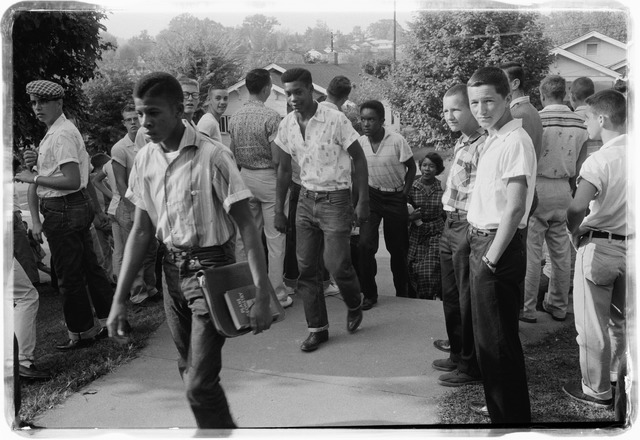
This is especially true when the Supreme Court makes a progressive decision for the benefit of our country, such as in Brown v. Board of Education. There is no question today that the Court made the right decision in that case, but at the time, the decision was immensely controversial. It was met with reactions varying from praise to hesitation to armed resistance to racial slurs. All over the country, parents protested the integration of schools. They attempted boycotts, they formed picket lines outside of schools, and they demanded that local officials pass laws that hindered integration as much as possible. School boards in the South went to great lengths to find ways around integrating their schools, and extremist groups like the Ku Klux Klan threatened and carried out violence against those who supported integration. In short, many white Americans, especially in the South, were outraged by the Court's decision in Brown v. Board of Education.
The road to integration that followed was not easy, even when federal troops were sent in to force the process. Students of color faced harassment in schools that opposed integration, and several additional lawsuits were filed to address the legislation states passed to hinder integration and to reverse the policies school boards put in place to stop it. From 1955-1960, there were more than 200 desegregation cases. People who fought for integration often faced major hardships, such as being fired from their jobs or being denied loans for homes or businesses. Actual integration was slow, and some schools in the South were still not integrated more than ten years later.
It took additional legislation in the form of the Civil Rights Act of 1964 to fully implement the intentions behind Brown v. Board of Education. During the 1970s and '80s, students were bused across town, far from their neighborhoods, to integrate schools. In many areas, even that was not enough. In the 1990s, several federal laws mandating integration were repealed and many affluent, white families fled cities for the less racially diverse suburbs. This practice resulted in a renewed type of segregation. Today, the most segregated schools are in the inner cities of New York and Chicago. More than 80% of schools with a majority of African American and Latino students are in high poverty areas. Court cases are still being argued today about the equality of education in areas like these.
As you can see, while Supreme Court decisions can have a long-lasting impact on how government functions, these decisions often elicit strong reactions from people who are emotionally invested in the issue at the center of the case. Supreme Court decisions can create de facto laws that impact both individual citizens and American culture for decades. With so much as stake, it is no wonder that actions of the Supreme Court can cause major controversy.
Question
Were any additional groups affected by Brown v. Board of Education?
