Supreme Court decisions have been known to cause controversy throughout American history. However, cases heard since the 1950s when televisions became commonplace in American homes have been particularly dramatic in their effects. Use the tabs below to learn about some 20th century landmark Supreme Court cases that have caused significant controversy. Read through each tab to learn about the case and what controversy it caused.
Miranda Rights
Affirmative Action
Contract Incentives
Same Sex Education

Miranda v. Arizona is actually a collection of cases related to a defendant pleading guilty without first being read his Fifth Amendment rights--such as the right to an attorney or the right to remain silent. Mr. Miranda was arrested in 1963 during an investigation for a kidnap and rape case. After two hours of questioning, he gave a written confession, which was used during trial and led to his conviction for the crime. Police agreed he was never informed of his right to have an attorney present for his questioning. The question the lawsuit raised was is it a violation of your Fifth Amendment rights to not be warned of your rights when in police custody?
Recall what you have learned about this case and its outcome and see if you can answer the questions below.
| What was the constitutional basis of Supreme Court's decision? | The Fifth Amendment requires police to inform suspects of their right to remain silent and their right to an attorney during police questioning. |
| Why was the ruling controversial? | Many people were outraged that Miranda’s kidnapping and rape charges were overturned on a technicality. (Without the confession, there was not enough evidence to convict him again.) Also, many people, including four of the justices on the Supreme Court, argued that the strict interpretation of the Fifth Amendment limited police officers’ ability to complete an investigation. |

In the 1977 case, Regents of the University of California v. Bakke, a white man was denied admission to the University of California medical school. At the time, that institution had a policy that reserved a certain number of seats for minority applicants. Mr. Bakke’s credentials exceeded those of all the minority students granted admission, and he sued the school, claiming reverse discrimination. Bakke argued that the school's use of affirmative action in its admission policies violated his right to equal protection.
| Which part of the Constitution did Bakke cite in his petition to the Supreme Court? | the Fourteenth Amendment |
| The Court agreed that quotas violated the Constitution, but it also upheld affirmative action. How could it do both? | Affirmative action allowed race to be used as one criteria when making admissions (or hiring) decisions. As long as a school does not establish specific numbers of each race to admit (a quota, in other words), students belonging to a racial minority may receive preference. |

In Adarand Constructors, Inc. v. Pena, a construction contract company that had submitted a bid for a federal government wanted to hire another construction company to help with the work as subcontractors. The federal government would pay the first construction company a bonus if they hired minority-owned businesses to do the subcontract work. Adarand, who was white, would have gotten the job if it had not been for the bonus for hiring a minority owned business. Adarand filed a lawsuit claiming that it was a violation of due process to presume that all minorities were disadvantaged and warranted special treatment.
The case led to a change in the law: The Supreme Court ruled that any race-based incentives "must serve a compelling government interest, and must be narrowly tailored to further that interest." In other words, the Court agreed that a group should not always get favorable treatment just because there had been discrimination in the past. Therefore, to have a bonus program based on race alone is not acceptable.
Why do you think the Supreme Court's decision was controversial?
This case is controversial because it removed the presumption of disadvantage from minority groups. The ruling of the Court required any race-based preferences to be strictly reviewed by the courts. Its effect was to limit the use of affirmative action in government programs. The role of affirmative action should play in modern society is still routinely debated.
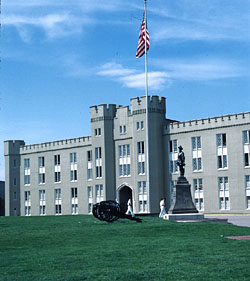
The Virginia Military Institute (VMI) is a public university that once admitted only males to the program. VMI was the last all-male public university in the country, and it had retained that status by arguing that admitting women, who were thought to be weaker, to a military academy that would push their physical limits in a dangerous way or lead to a lowering of physical standards for the school's male students.
In United States v. Virginia (VMI), the United States government sued the state of Virginia and VMI, claiming its admissions policy was a violation of equal protection under the Fourteenth Amendment. Virginia tried to respond by setting up an equal university that was female-only, but the Court did not accept this.
The Supreme Court ruled that admission decisions based on gender must show an “exceedingly persuasive justification" and that VMI had not done so. What does the decision mean in plain English?
There must be an incredibly good reason or you cannot deny admission on the basis of gender.
Question
Does the Supreme Court hear every case brought before it?
