Think about it: A major historical event like the battle of Puebla is likely to leave hundreds of artifacts behind. In this context, Resolution 440 is a pretty small piece of the puzzle. A thorough analysis of Cinco de Mayo would include secondary sources like encyclopedia entries, history textbooks, and even war reenactments. (Did you know that every year, the people of Puebla outfit themselves with traditional 19th-century clothing and weapons to recreate the battle?) Primary sources, if we can find them, can be vital to the understanding of an event like the battle at Puebla. Primary sources would include photos of the soldiers who fought that day, orders that the generals gave their commanders, or diaries from civilians affected by the war.
Sometimes you find enough information in primary and secondary sources to complete a careful analysis. Often, though, to really understand an event, you have to find out what led up to it, and what its effects were. Even if we learn that the event didn't change the world, we can learn something that helps us understand how the event came to represent something important.
To broaden our perspective of Cinco de Mayo, let's read an account of Mexico's history before, during, and after the French invasion. As you read, consider how an event that didn't change the course of history came to be such a powerful symbol nonetheless.
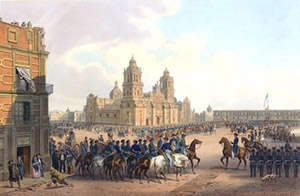 The war between the U.S. and Mexico was bloody, and many Mexican citizens died. Rather than simply holding the borders of Texas, American troops invaded Mexico and marched on Mexico City. They took over Mexican territory in California, New Mexico, and Arizona. When a treaty was finally signed in 1848, the agreement granted these areas to the United States. Another term of the treaty surprised many Americans. The United States agreed to pay Mexico $15 million for the land it took from Mexico during the war. Its leaders felt that it was better to try to be generous toward its much-weakened neighbor rather than allow too much resentment to grow among the Mexican people. In the end, most people were tired of the war, and so supported the treaty.
There were many Americans who regretted the Mexican-American War. Popular support for it was not as strong as had been believed during the conflict. Many people felt that while the United States had acquired land, it had also lost its innocence. It was now a military aggressor, pushing its will onto a poorer nation, and no longer the downtrodden righteous freedom fighters of the American Revolution. There were many American soldiers who had deserted, believing the war to be unfair. There were other soldiers who had been forced to enlist. Some people had been jailed for opposing the war, such as the famous philosopher and writer Henry David Thoreau, who refused to pay taxes because he did not want his money used to pay for the war. The poet Ralph Waldo Emerson predicted the war would “poison us.”
Its war with the United States left Mexico's government defeated and humiliated. The Mexican people were ready for a new approach, and thus were inspired by Benito Juarez, a full-blooded Indian who, with the help of his friends, took control of the Mexican government. Juarez and his supporters were called liberals, and they wanted to make education and opportunity available to all the people while making the Roman Catholic Church in Mexico less powerful. Wealthy landowners and churchmen felt threatened by Juarez's plans, and the French emperor Napoleon III invaded and gained control of Mexico on their behalf.
Napoleon made Ferdinand Maximilian the emperor of Mexico. Maximilian and his wife Carlotta ruled Mexico from a splendid palace in Mexico City. The United States did not like having a European power so close to its borders, however, and convinced the French troops to leave in 1867. Mexico then fell into the hands of Porfirio Diaz, a dictator who ruled Mexico with an iron will. He used a well-disciplined police force on horseback called the rurales, who were dreaded by everyone. They would ride around the countryside, making sure that people were too frightened to protest. While Diaz did much to modernize Mexico, such as building bridges and railroads and encouraging trade, his projects mostly benefited Mexico's wealthy landowners.
Eventually, a new revolution for independence began in Mexico. A man named Zapata, who was an Indian, assembled an army of peasants willing to fight for freedom and opportunity. Another man, Pancho Villa, led a band of cowboys in guerrilla attacks against the haciendas, or huge farming estates, of the wealthy elite. In the war that followed--between the wealthy conservative creoles and the mestizo peasants--millions of Mexicans lost their lives. Everyone fought--men, women, and children. A new Constitution, based on democratic principles, was written during this time, but it was not enforceable until the bloodshed ended. Mexicans have many stories and songs about this time in the life of their country. Even after the fighting was over, democracy was not a reality for another twenty years.
Question
Although the battle at Puebla was a surprise defeat for the French, it hardly slowed them down in their ultimate conquest of Mexico. Why, then, do you think Cinco de Mayo became such a large event in the memory of Mexicans and eventually Americans?
