To make a CD, the incoming analog sound waves are captured using a microphone in the same way as for an LP. Instead of the sound waves being directly transferred to the CD however, the sound waves are taken apart and turned into a code by an analog-to-digital converter (ADC). This technology is called signal sampling. As the electric signal comes into the ADC, its amplitude and frequency are read (or sampled) at regular intervals. Each reading (each sample) is then assigned a numerical value between 0 and 65,536. The sound is then encoded and stored on the CD as a series of bumps in a continuous spiral track on the disc. We often hear these bumps referred to as pits. CDs have 44,100 samples per second. The data track is microscopic, as are the pits on it. The The track is only 0.5 microns wide (a micron is a millionth of a meter).
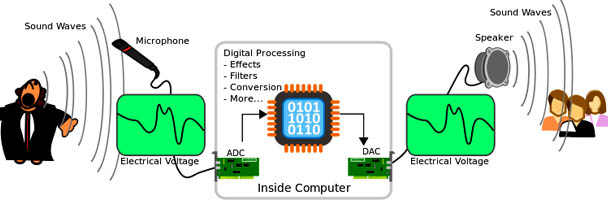
The illustration above shows a flow of audio from sound waves through a microphone to an analog-to-digital converter (ADC) and into a computer. The code goes from the computer into a digital-to-analog converter (DAC), into a speaker and finally as sound waves again.
Take a few minutes to look at a CD. Observe what it looks like, what it feels like and then what it sounds like. Record your observations in the Music Data Table.
CD
What type of value is each sound in a CD assigned?
A numerical value.
