There are three major classes in phylum Mollusca--Gastropoda, Bivalvia, and Cephalopoda.
Snails and slugs fall into class Gastropoda and have their own special traits that separate them from other classes of mollusks. For example, the foot in terrestrial gastropods is modified for life on land. All terrestrial gastropods have a foot that secretes a mucus that helps them glide on land.
Bivalves include mussels, oysters, scallops, and clams. Like gastropods, some bivalves are important foods for humans. Read through the activity below to learn about class Bivalvia.
Shells
Habitat
Locomotion
Feeding
Senses
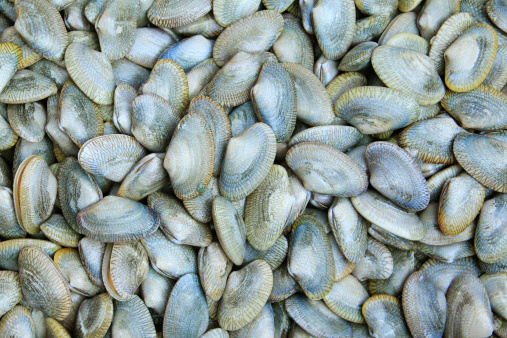
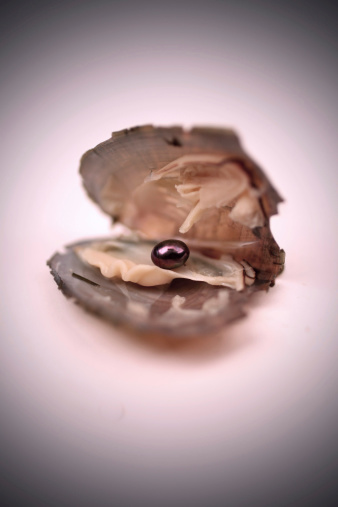
Bivalves are responsible for the creation of pearls.
Bivalves, as their name implies, have two valves or shells. Notice all the baby clams in the picture have two shells. What part is involved in creating the shells of mollusks? Think of the answer, then click "Show Me" to see if you are correct.

The mantle creates the shells of mollusks.
The mantle is also responsible for the pearl formation in bivalves. When an irritant like a grain of sand gets lodged in between the mantle and the shell of a bivalve, the mantle responds by coating the irritant with nacre, the same substance that forms the inner part of the shell. Nacre is also known as "mother of pearl." Eventually a pearl is formed by layers and layers of nacre coating the irritant.
The valves in bivalves are held together by a hinge and are connected to the soft body inside by special muscles called adductor muscles. When the adductor muscles contract, the valves close.
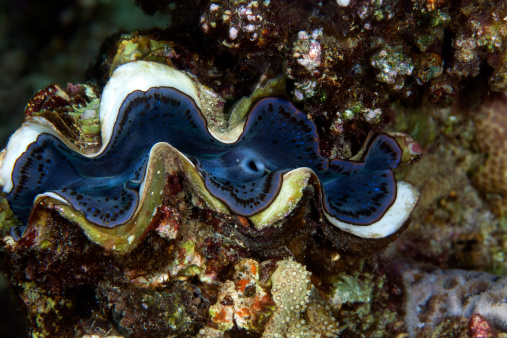
All bivalves live in water, either fresh or salt, although most live in salt water. What is another name to describe salt water habitats? Think of the answer, then click "Show Me" to see if you are correct.
Marine is another name for salt water habitat.
Pictured is a giant clam, which lives in the Red Sea.
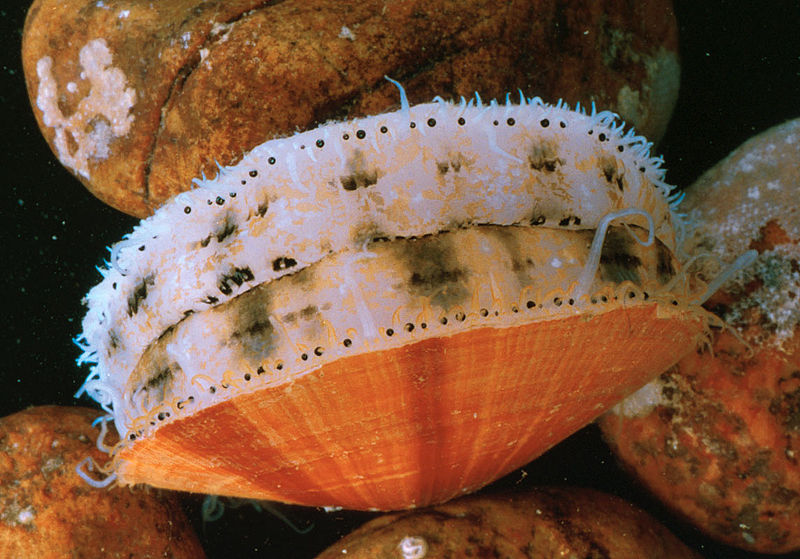
Very few bivalves are capable of swimming, like this deep sea scallop.
The majority of bivalves are sessile. What does sessile mean? Think of the answer, then click "Show Me" to see if you are correct.
Sessile is a characteristic of some animals that remain stationary and planted to one spot for the entire span of their lives.
Sessile bivalves remain in place by inserting their muscular foot into the ground. Although most bivalves live a stationary life, there are a few that can move. For example, the deep sea scallop is able to open and close its valves rapidly. When it closes its valves, jets of water push the animal through the water.
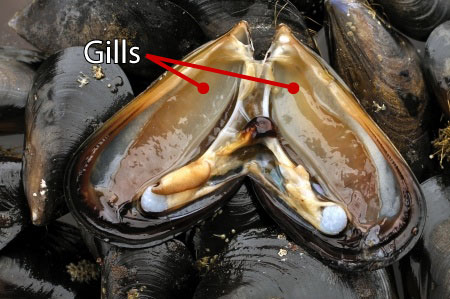
All bivalves are filter feeders. They lack the radula that all other mollusks have. They have cilia that bring water over their gills, which are coated in mucus, as seen in the photo. The mucus traps small organisms and food particles. The food then flows to the mouth where digestion begins.
Besides the digestive system, what other system do mollusk gills belong to? Think about the answer, then click "Show Me" to see if you are correct.
Gills are part of the respiratory system.
![By Nhobgood Nick Hobgood (Own work) [CC-BY-SA-3.0 (http://creativecommons.org/licenses/by-sa/3.0) or GFDL (http://www.gnu.org/copyleft/fdl.html)], via Wikimedia Commons](https://s3.amazonaws.com/cms.accelerate-ed.com/image/fc82dd2c-13e6-4c31-bf09-2b4e80104a96.jpg)
Unlike other mollusks, bivalves have no distinct head region, but they are still able to sense their environment. They have a bundles of nerve cells above their foot that serve as a simple brain and sense organs that are sensitive to light and touch. Pictured is a coral scallop with numerous bundles of nerve cells, which are red colored circles with blue centers.
What part of gastropods is sensitive both light and touch? Think of the answer, then click "Show Me" to see if you are correct.
Gastropods have tentacles with eyes attached to the ends that are sensitive to light and touch.
Test your understanding of the characteristics of bivalves by completing the activity below.
| Use the dart to pop any balloons that contain bivalve attributes or characteristics. |
Complete
