All mollusks have a visceral mass, mantle, and foot. What are the functions of each of those regions? The visceral mass is the central region where all the organs are located. The mantle is a heavy fold of tissue that surrounds the body and creates the shell. The foot is a highly muscular region that helps the mollusk move around.
Click through the activity below to learn about the other three body parts of mollusks.
Coelom
Radula
Shell
![By KDS444 (Own work) [CC-BY-SA-3.0 (http://creativecommons.org/licenses/by-sa/3.0)], via Wikimedia Commons](https://s3.amazonaws.com/cms.accelerate-ed.com/image/42f35aba-cd7b-48ce-8966-80b91a8bfd5b.png)
All mollusks have a coelom, which is a true body cavity containing fluid and completely lined with mesodermal tissue. The coelom surrounds all the organs, as pictured in the cross-section of the animal above. This trait is a characteristic of all complex animals. The simplest animals lack a coelom, including placozoans, poriferans, and cnidarians.
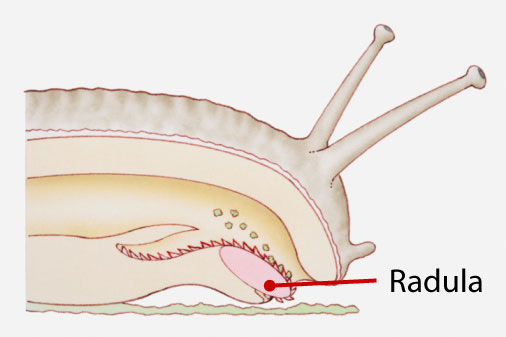
All mollusks, with the exception of bivalves, have a radula, which is a tongue-like structure located inside the mouth. The radula is specialized to scape objects for food--for example the algae off rocks or leaves into shreds. The radula is able to scrape because there are teeth on its surface, curved backwards. The mollusk sticks out its radula to scrape for food then returns with the food to the mouth to be swallowed.
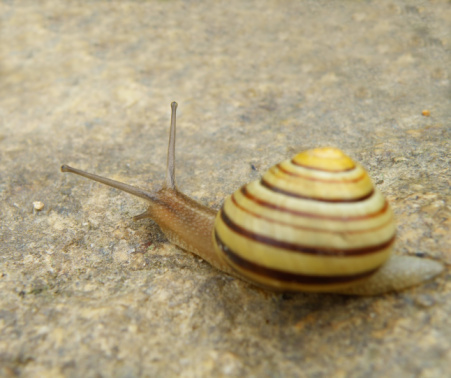
Snails, like the one pictured, are mollusks with a single shell.
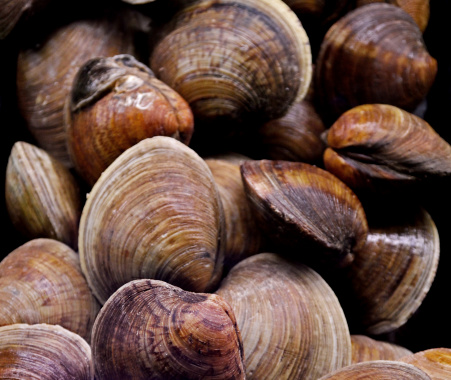
Clams, like the ones pictured, are mollusks with two shells.
Almost all mollusks have one or two shells. The shell acts as a strong and hard exoskeleton to support and protect the soft body underneath it. The mantle secretes thin sheets of protein and a hard mineral called calcium carbonate, which are the materials that compose the shells.
What other animal contains a structure with calcium carbonate? Think of the answer, then click "Show Me" to see if you are correct.

Calcareous sponges (poriferans) contain calcium carbonate within their skeletons.
In the activity below, match the body part with its description.
|
foot
mantle
visceral mass
coelom
shell
radula
|
region of the body where the organs are located
a fluid-filled cavity that contains all the organs
heavy fold surrounding the mollusk body that creates the shell
tongue-like structure with teeth on its surface, located in the mouth
muscular region used for movement
hard exoskeleton made of protein and calcium carbonate
|
