All mollusks have a visceral mass, mantle, and foot. They have digestive systems with a modified tongue called a radula, a mouth, a digestive tract, and an anus where all the solid waste are excreted. All the organs are located within a fluid-filled cavity called the coelom. Connected to the coelom is the nephridia, which rids the mollusk body of liquid waste. All mollusks must breathe oxygen, with either a simple lung or gills, located within the mantle cavity. Some mollusks have tentacles and eyes.
Click through the activity below to learn how to draw a gastropod, specifically a snail.
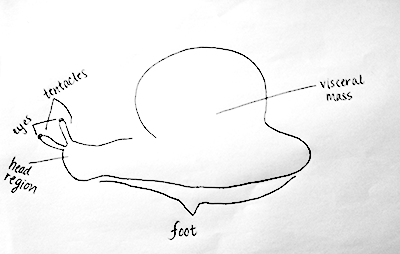
Outline of a Snail
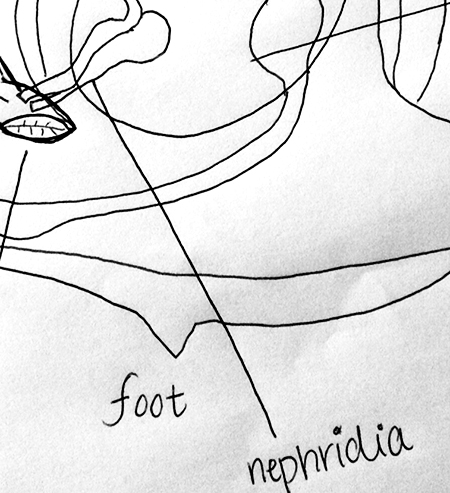
The first step in drawing a mollusk is to draw the visceral mass, which has a circular shape and is the central region of the body. Below it, draw a foot that is slightly rectangular but has curved edges. On one end of the rectangular foot, a rounded head region should be drawn and on top should be two tentacles. On the tips of tentacles are little protrusions which represent the snail eyes. Label the visceral mass, head region, foot, two tentacles, and eyes. Shell, Mantle, and Coelom
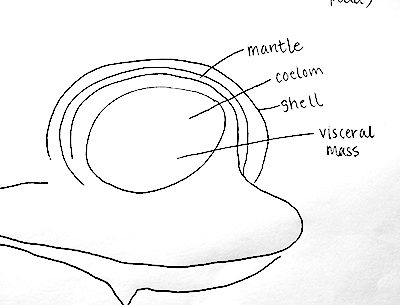
Draw a shell covering the visceral mass. Underneath the shell, draw a thin layer to represent the mantle. Underneath the mantle and within the visceral mass, draw a circle to represent the coelom. Label the shell, mantle, and coelom. What important part of the mollusk body does the mantle create? Think of the answer, then click "Show Me" to see if you are correct.
The mantle creates the shell. Mouth and Radula
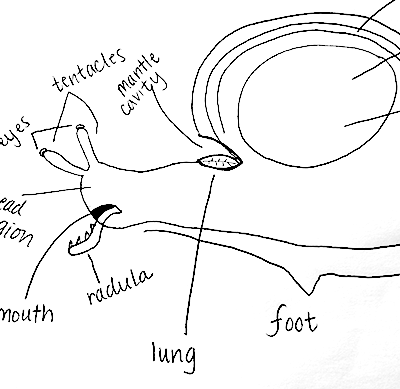
Draw a mouth with the radula sticking out near the head region. Be sure to draw the backward curved teeth on the surface of the radula. Label the mouth and radula. What is the purpose of the radula? What mollusk class contains animals with no radula? Think of the answer and click "Show Me" to see if you are correct.
The radula scrapes food off rocks and plants. It can also bore holes in shells to get to the soft bodies underneath. Class Bivalvia contains mollusks that lack radula. Mantle Cavity & Lung
Draw a circular open space underneath the anterior end of the shell to represent the mantle cavity. Within the mantle cavity, draw a single thin lung, shaped like a tear drop. Label the mantle cavity and lung. What do mollusks that live in water have in place of a lung? Think of the answer, then click "Show Me" to see if you are correct.
Mollusks that live in water have gills instead of a lung. Digestive Tract, Anus, and Nephridia
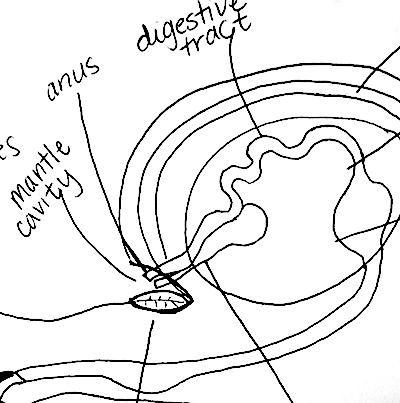
Draw the digestive tract by drawing a tube starting at the mouth, up into the visceral mass, and folded inside the coelom. The tube should have an opening that goes out to the mantle cavity. This opening represents the anus. Draw another tube coming from the coelom and ending at the mantle cavity. This tube represents the nephridia. Label the digestive tract, anus, and nephridia. What is the purpose of the nephridia? Think of the answer, then click "Show Me" to see if you are correct.
Nephridia release fluid waste from the body. It is also the site for nutrient reabsorption before the waste is excreted. |
 |


Click the activity button below to access the Drawing Mollusca worksheet. On this worksheet, you will draw and label a diagram of a snail that belongs to Class Gastropoda. When you have completed this worksheet, submit it to your teacher.
