The third major class of mollusks is Cephalopoda, which includes octopuses, squids, nautiluses, and cuttlefish. What are the other two major classes of mollusks, and what animals are included in these classes? Think of the answer, then click "Show Me" to see if you are correct.

The other two major classes of mollusks are Gastropoda (snails and slugs) and Bivalvia (clams, oysters, mussels, and scallops).
Cephalopods are the most complex of all mollusks and the most intelligent of all invertebrates. Click through the tabs below to learn about the third major class of mollusks--Cephalopoda.
Shells
Habitat
Locomotion
Feeding
Senses

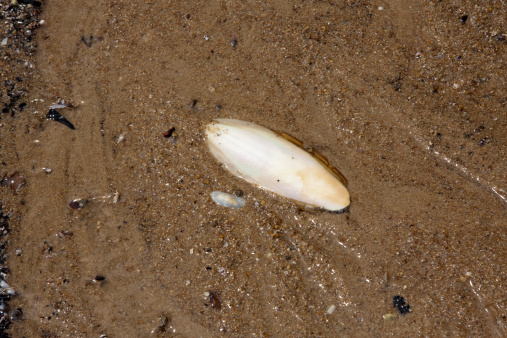
After the cuttlefish died its internal shell washed ashore on the beach.
Most cephalopods have evolved to not have shells, although there are a few exceptions. The nautilus is the only cephalopod that still has a single shell exoskeleton, as pictured. The cuttlefish also has a small internal shell that has human uses, such as jewelry making and a calcium dietary supplement for many pets including birds, reptiles, and hermit crabs.
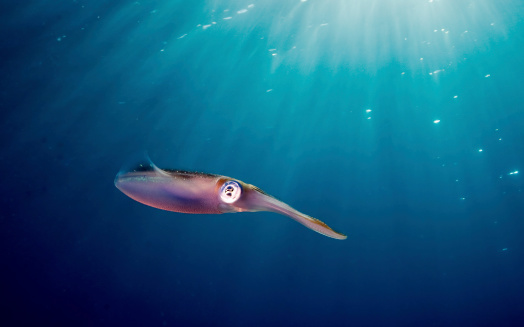
All cephalopods are marine animals, that is, they live only in salt water. Pictured is a squid in its habitat, the ocean.
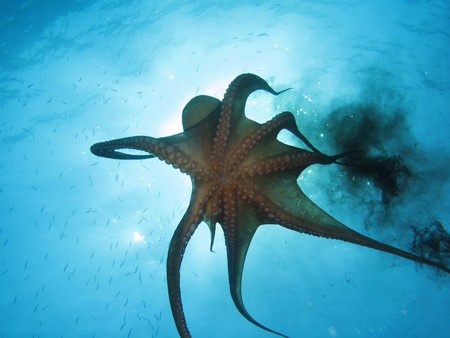
Octopuses such as this giant octopus, release ink through their siphon.
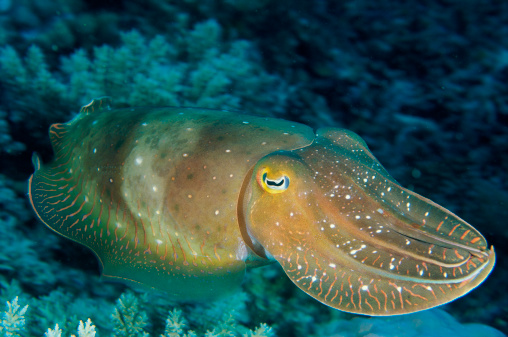
This cuttlefish produces a very important ink, sepia.
All cephalopods swim by means of jet propulsion. Cephalopods let in water through their mantle and then expel it quickly through a tube structure called a siphon. It is this drawing in and pushing out of water that allows cephalopods to move quickly.
Some cephalopods also release a dark fluid or ink from their siphons when they are escaping predators or when they feel endangered. This release of ink clouds their trail of escape, which is exactly what the octopus is doing in the image. The cuttlefish releases a special ink called sepia that has been used for centuries by artists.
How do cephalopods move around? Think about the answer, then click "Show Me" to see if you are correct.
Cephalopods move around by jet propulsion--letting in water through their mantle and pushing the water out through their siphons.
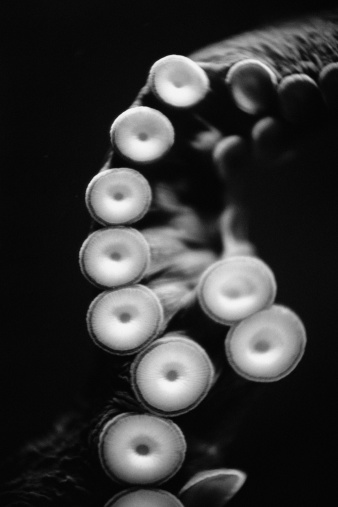
Octopuses have suction cups attached to their eight tentacles that they use for capturing prey.
In cephalopods, the foot is modified to help in the digestive process. For example, the octopus's foot is divided into eight parts or tentacles. The nautilus has 80 to 90 tentacles, while the squid has 10 tentacles. Attached to the tentacles are suction cups or multiple harpoon-like structures that both help in capturing their prey--all cephalopods are ravenous predators. They bring their food to their mouth using their tentacles. Cephalopods have beak-like jaws that help tear their food to pieces. Once the food is torn to shreds, those shreds are pushed into their mouth with the radula. Cephalopods eat fish, worms, other mollusks, and crustaceans.
How are gastropod tentacles different from cephalopod tentacles? Think of the answer, then click "Show Me" to see if you are correct.
Gastropods have a pair of tentacles on top their head region with eyes on the tips that are sensitive to light and touch. The cephalopod tentacles are actually a modified mollusk foot that contains suction cups or harpoon-like structures.
![By Dylanmonch vigote (Own work) [CC-BY-SA-3.0 (http://creativecommons.org/licenses/by-sa/3.0)], via Wikimedia Commons](https://s3.amazonaws.com/cms.accelerate-ed.com/image/dfb830f0-4d42-4320-8aed-16453db6d803.jpg)
The giant squid is the largest invertebrate in the world with the most developed and largest eye among all invertebrates and some vertebrates.
Cephalopods have a highly developed head region with a complex nervous system. Cephal is Greek for head. This is why cephalopod is the name for those mollusks that have the most developed brains. They are the most intelligent of all invertebrates and are the only invertebrate that can be trained to distinguish different shapes and patterns. Many aquarium-dwelling octopuses can figure their way out of their tanks while searching for food. Some cephalopods have been seen climbing aboard ships and cracking open and eating the crabs on board.
Cephalopods also have highly specialized eyes. Some even have color vision. The world's largest invertebrate, the giant squid, also has the largest eye, bigger than some vertebrate eyes.
| What is the purpose of a siphon in cephalopods? | The siphon expels water quickly to propel the cephalopod forward. It is also where ink can be expelled to cloud their route of escape when in danger. |
| What are four animals in class Cephalopoda? | Octopuses, squids, nautiluses, and cuttlefish are all in class Cephalopoda. |
| What is the only cephalopod with an external shell? | Nautiluses are the only cephalopod with an external shell. |
| What mollusk class has the most complex nervous system? | Class Cephalopoda contains mollusks with the most complex nervous system. |
