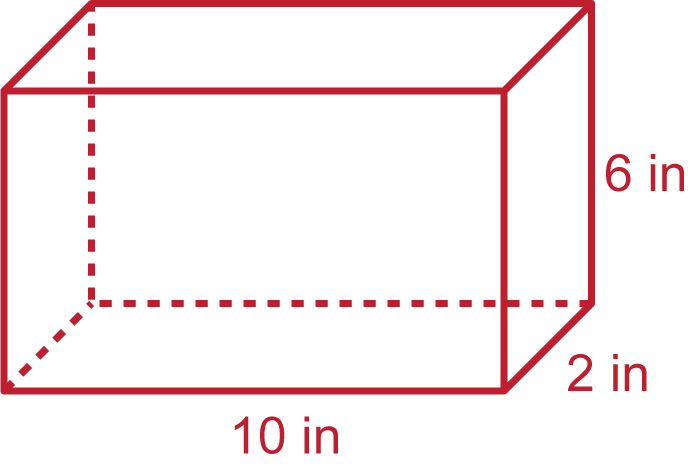
Rhoda is trying to wrap a present she bought Becky for her birthday. How much gift wrap will she need? To answer this question, you need to find the surface area of the box Rhoda plans to wrap. The surface area of a three-dimensional figure is the sum of the areas of all the outside surfaces. The box Rhoda is planning to wrap is a rectangular prism that has a length of 10 inches, a width of 2 inches, and a height of 6 inches. The amount of wrapping paper she needs is equal to the surface area of the box.
|
From a perspective view, the box would look like this:
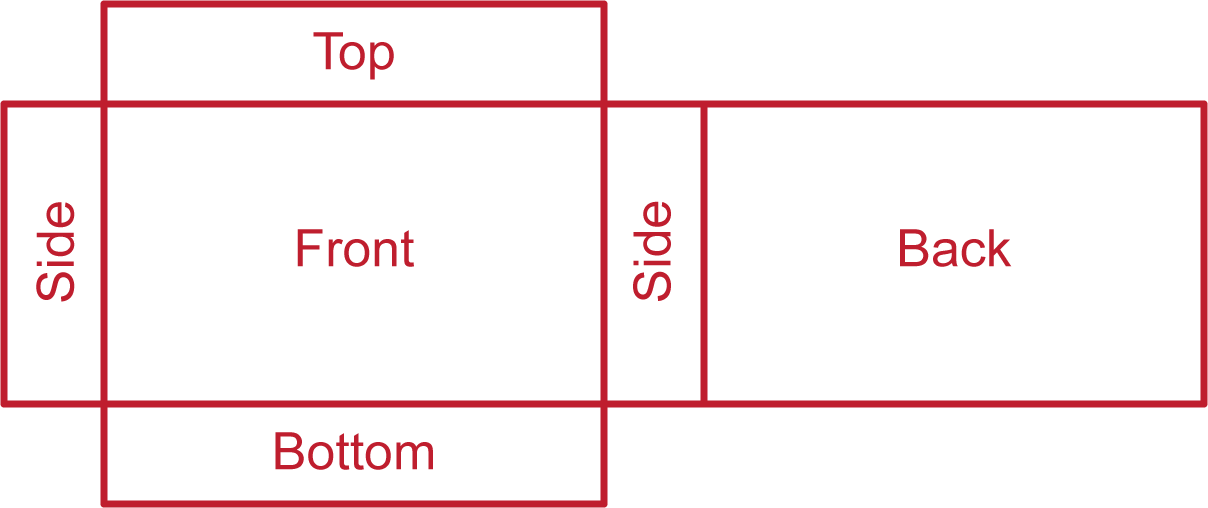
If you were able to lay the box flat so that each of its sides was part of the same plane, it would look like the figure below. This representation of a three-dimensional figure is called a net.
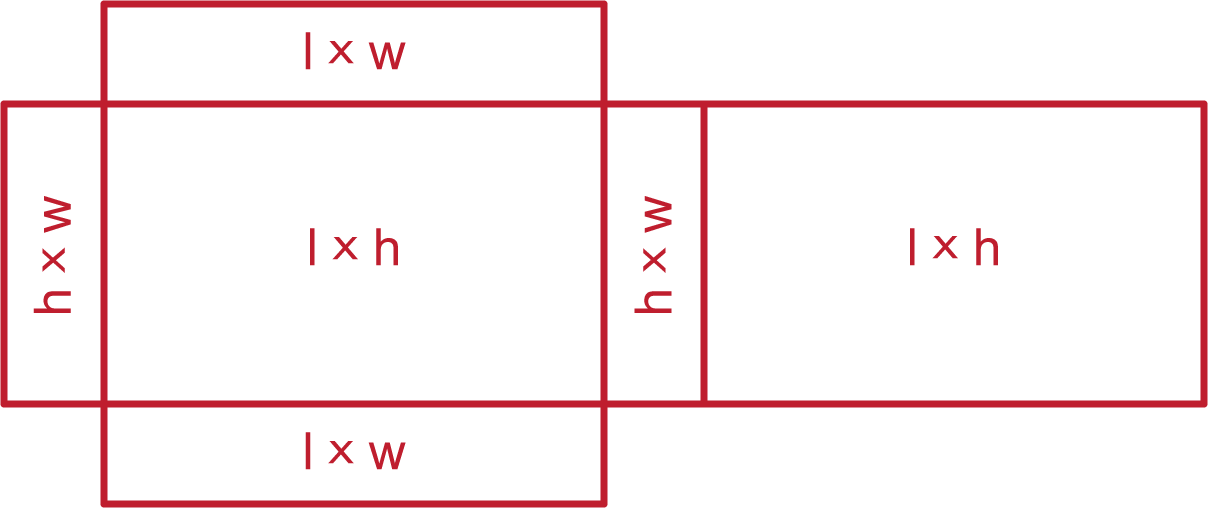
To find the surface area of the box, we need to find the area of each of the six sides (rectangles) and add them together.
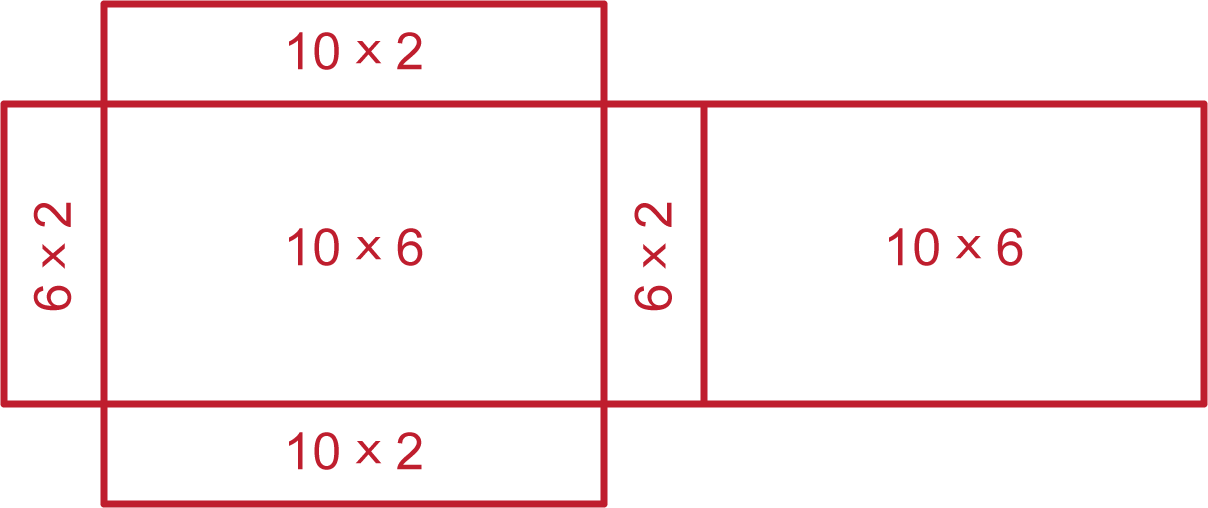
If we substitute the length, width, and height into our net, it will look like this:
We are ready to find the surface area of Rhoda’s box. We will use SA to represent the surface area.
The surface area of the box Rhoda wishes to wrap is 184 square inches (or 184 in.2). |
 |