Within a given population, individuals may not be spaced evenly throughout the inhabited area. For example, look at the map below of sub-Saharan Africa. The map on the left shows the density of vegetation (how many plants there are in a unit of area). Compare this to the image on the right, which shows the density of humans in the same area.
Why do you think the population density of humans differs from area to area? What do you see when you compare the density of vegetation to the density of the human population? Think about the answers and then click Answer to see if you are correct.
Humans are concentrated in areas where plants can grow. This is because they can eat the plants, as well as the other animals that feed on these plants. The presence of vegetation also indicates that there is water available in the area. Animals are dependent upon water and food in their habitats, as well as climates that are hospitable to life. The majority of animal life is concentrated in areas with temperate climates and with water and food available year-round.
Density of Vegetation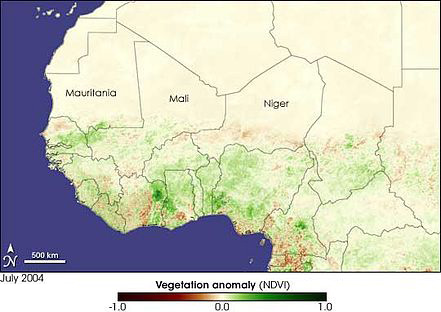 |
Density of Humans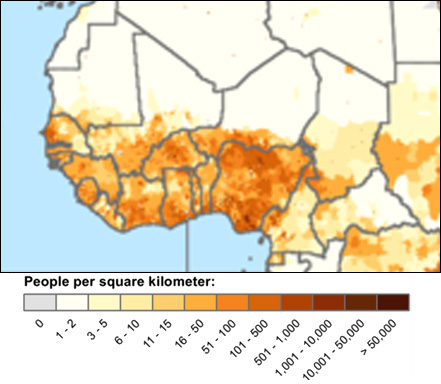 |
As you can see by looking at the map, population density is not constant from place to place. The way individuals of a population are dispersed throughout a given area is called its distribution pattern, which is another characteristic used to describe the population.
We can classify distribution patterns into three main types: uniform, random, and clumped. These patterns of distribution often correspond to traits of the population or how that population interacts with its environment. Click each of the images below to learn about the three types of distribution patterns. As you read about each pattern, consider how individuals and their environment interact and how this affects their distribution.
 Uniform |
 Random |
 Clumped |
Which of the following would affect the distribution pattern of a population?
- the genetic diversity of the population
- whether the population is evolving
- the distribution of resources
- whether it lives on land or in water
How a population is distributed in its inhabited area depends on the social behavior of the species and how resources like nest sites and food availability are distributed.
How a population is distributed in its inhabited area depends on the social behavior of the species and how resources like nest sites and food availability are distributed.
How a population is distributed in its inhabited area depends on the social behavior of the species and how resources like nest sites and food availability are distributed.
How a population is distributed in its inhabited area depends on the social behavior of the species and how resources like nest sites and food availability are distributed.
Summary
 Questions answered correctly:
 Questions answered incorrectly:
