Simon is designing a new roller coaster for a local amusement park. He wants the first hill of the coaster to be fairly steep so that the coaster's train cars gain a lot of momentum on their descent. The momentum the train gains as it descends the first hill will carry the passengers through the remainder of the ride.
In his design, the height of the roller coaster's first hill over time can be represented by the quadratic equation \( - \frac{1}{2}x^{2} + 10x - 20 = 0 \).
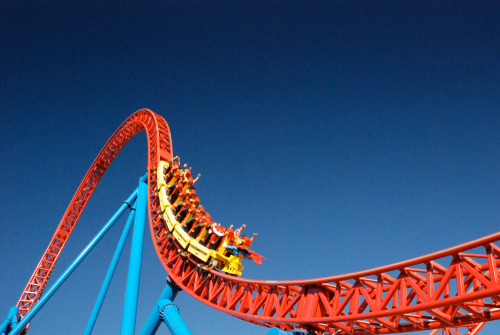
How long will it take for the roller coaster's train cars to ascend the first hill and then take the plunge?
To determine how long it will take for the train cars to ascend and then descend the first hill, you need to start by solving the given quadratic equation. You already know several ways to solve quadratic equations. Each of these techniques has its own strengths and weaknesses.
| Method | Strength | Weakness |
|---|---|---|
Graphing |
Provides a picture of the equation. |
Creating a graph by hand can be time consuming. |
Factoring |
When a quadratic equation is factored, you can use algebraic techniques to solve the individual binomials. |
The factors can be difficult to determine. |
Completing the Square |
Once you complete the square, you can easily use the square root property to solve the equation. |
If the leading coefficient of the quadratic equation is not 1, then you must divide both sides of the equation so that the leading coefficient is 1. Doing so can create messy fractions. |
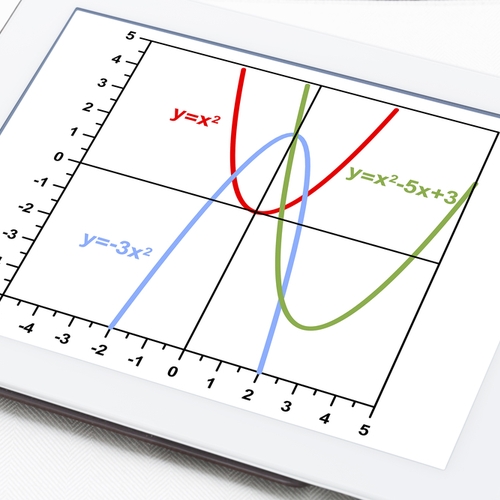

The best method for solving a quadratic equation often depends on the structure of the equation. Until you have sufficient practice, it can be difficult to know which method is the best for a given equation. Fortunately, there is a formula you can use to solve any quadratic equation, no matter its structure.
In this lesson, you will learn how to utilize this formula to solve quadratic equations. You will also use a part of the formula to determine the number and types of solutions a given quadratic equation has.
