The rules of transformations can be used to recognize the relationships between quadratic functions, even when not given information in the same format. Study the slides below to see how you can interpret transformations in a variety of ways.
Transformations Described in Words
The function \( g(x) \) is a parabola, opening upwards, with a vertex at \( (1,2) \).
The function \( g(x) \) described above is a transformation of the parent function \( f(x) = x^{2} \).
The function \( g(x) \) opens upwards, like the parent function, but the vertex has moved. An equation for \( g(x) \) could be \( g\left( x \right) = \left( x - 1 \right)^{2} + 2 \).
Transformations Described in a Table
\( \displaystyle x \)
\( \displaystyle g(x) \)
\( \displaystyle - 4 \)
\( \displaystyle - 16 \)
\( \displaystyle - 3 \)
\( \displaystyle - 9 \)
\( \displaystyle - 2 \)
\( \displaystyle - 4 \)
\( \displaystyle - 1 \)
\( \displaystyle - 1 \)
\( \displaystyle 0 \)
\( \displaystyle 0 \)
\( \displaystyle 1 \)
\( \displaystyle - 1 \)
\( \displaystyle 2 \)
\( \displaystyle - 4 \)
\( \displaystyle 3 \)
\( \displaystyle - 9 \)
\( \displaystyle 4 \)
\( \displaystyle - 16 \)
The function \( g\left( x \right) \), described above is a transformation of the parent function \( f(x) = x^{2} \).
The function \( g(x) \) closely resembles the parent function, but all of the \( y \)-values are negative. So, \( g\left( x \right) = - x^{2} \).
Transformations Described in Graphs
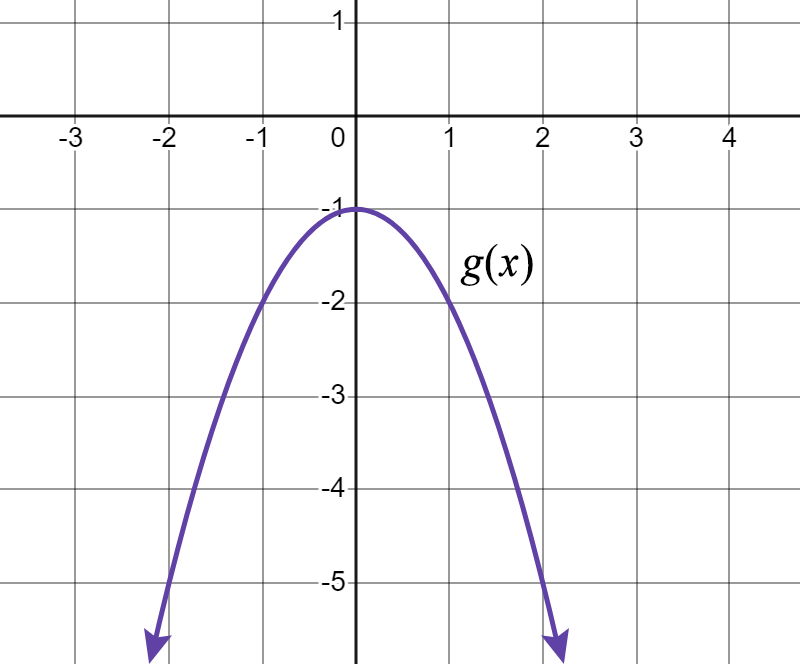
A parabola labeled \( g\left( x \right) \) that opens down, with a vertex at \( (0, - 1) \).
The function \( g\left( x \right) \) shows transformations of the parent function \( f(x) = x^{2} \).
The graph of \( g\left( x \right) \) shows two transformations:
The parent function has been flipped: \( f(x) = x^{2} \rightarrow - x^{2} \)
The vertex has been shifted down one unit: \( f(x) = x^{2} \rightarrow x^{2} - 1 \)
So, \( g\left( x \right) = - x^{2} - 1 \).
Transformations Described in Equations
\( \displaystyle g\left( x \right) = \left( x + 1 \right)^{2} \)
The function \( g(x) \) shows a transformation of the parent function \( f(x) = x^{2} \).
The equation of \( g\left( x \right) \) shows that \( x^{2} \) has been shifted one unit to the left: \( g\left( x \right) = \left( x - \left( - 1 \right) \right)^{2} \).
Let's Practice
Practice recognizing transformations. Look at each representation of a function and identify how the parent function \( f(x) = \left| x \right| \) has been transformed. When you think you know, click on the card to see the answer.
The function \( f(x) = \left| x \right| \) has been shifted down one unit. The translated function is \( g(x) = \left| x \right| - 1 \).
The function \( f(x) = \left| x \right| \) has been shifted three units to the right, and two units up. The translated function is \( g\left( x \right) = \left| x - 3 \right| + 2 \).
Text
Guided Notes
Tutor
Video
How To
Meet your new study partner! With our powerful Student Tools, your online learning experience just got more accessible,
personalized, and thought-provoking than ever before!
Do you feel like you learn better when you watch videos? You’re not alone!
Research shows instructional videos can make learners more engaged and active in online classes,
when compared to text-only lessons.
Student Tools lets you turn some lesson pages into videos instantly! Just click the Student Tools tab and select Video.
Remember, video instruction is not available on every lesson page.
Go back to the lesson page any time by closing the Student Tools window.
Sometimes when you learn, it can feel like you’re just not getting it. Maybe you don’t really know what all the words on
the page mean, or you have to read a paragraph two or three times to understand what it’s about.
If this happens to you, just click the Student Tools tab and choose “Text.” This will automatically
simplify the instruction, making it easier to understand and remember.
Go back to the lesson page any time by closing the Student Tools window.
The science is in, and taking notes is one of the best ways to reinforce your learning.
Notes work even better when you write them by hand, since you’re more likely to put complex new ideas
in your own words and remember them longer.
You can quickly and easily access guided notes, as well as key lesson vocabulary,
by clicking Student Tools > Notes. Choose a PDF or Word Doc,
and fill them out online -- or even better-- print them out and take notes by hand!
Go back to the lesson page any time by closing the Student Tools window.
Imagine a teacher you can contact anytime, who is happy to answer all your questions and
knows pretty much everything in the world about the subject you need help with.
Say, “Hello!” to your Tutor! Click on Student Tools > Tutor, and ask any question about your class.
Your Tutor is super smart! You can ask the Tutor to explain things more clearly, make connections
between ideas, or even give you custom quizzes and feedback. You can click the links under References to learn more.
Go back to the lesson page any time by closing the Student Tools window.
Student Tools lets you create your own Flashcard decks to help you study. To get started, click Student Tools >
Flashcards. Press Add New Set and give it a title.
Now, decide what will be on the front and back of your first card. It can be a term and definition, a challenging question,
or even a funny phrase that helps you remember something. Click Add Card to Set to make a new Flashcard.
You can delete sets or cards by clicking the trash can icon. When you’re done, click Save Cards to Set.
Now you can Review your deck. Read the front of the card, and think of the answer. Even better, say your answer out loud! Then, click the card to flip it over.
Depending on how you did, you can either keep that card in the deck to study again by clicking Next or Previous, or if you got it right, click remove.
Remember to review your flashcards often, space out study sessions, and keep practicing until you know them all!
Go back to the lesson page any time by closing the Student Tools window.