At the time when Roosevelt was entering politics, the nation's borders had expanded from one coast to the other in a little more than a century. The entire Caribbean region had been subdued or acquired as a territory while both Canada and Mexico had been pacified during the War of 1812 and the Mexican War (1846-48). In the early 20th century, the eastern, northern and southern U.S. borders were relatively secure.
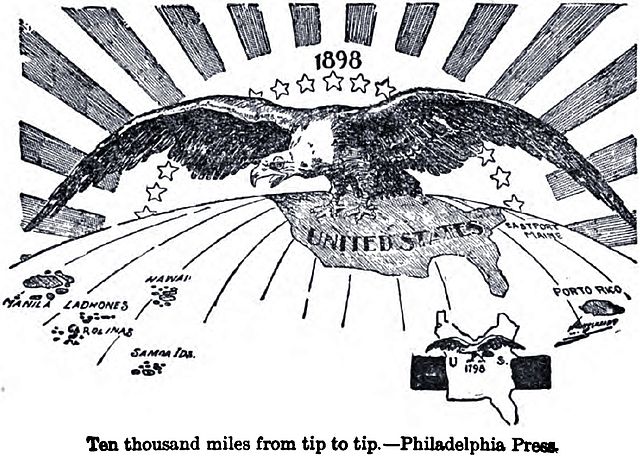
The expansion of the United States into Texas, Alta California (i.e., California, Nevada, New Mexico and Arizona), and the American West had continued with only the opposition from the Native Americans and the Pacific Ocean to limit the new nation’s growth. However, after the elimination of slavery in the U.S. following the Civil War, the American public had begun to agitate for U.S. military intervention in Cuba and the Philippine Islands, hoping to eliminate slavery there as well.
Since U.S. territory now extended from San Diego to Seattle, it seemed to Roosevelt and his military advisors that it would be prudent to prepare a coastal defense system that included the west coast. The easiest way to accomplish this goal would be to re-position ships from the east coast to the west coast. That's when the concept of a canal through the middle of Central America began to look especially appealing. The idea for a Panama canal, in particular, dated back to the 16th century, and for Roosevelt the commercial advantages of building the canal seemed another compelling reason to try to get the job done.
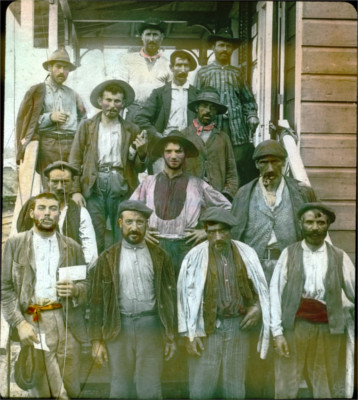
The Hay–Pauncefote Treaty of 1901 gave the United States a 10-mile piece of land for the canal. The cost to the US taxpayer was $10 million with an annual payment of $250,000 for the right to collect fees from ships using the canal. Many engineers thought that a canal through Nicaragua might also be possible, but the Senate selected Panama. Roosevelt and Taft would later take measures to prevent European competitors from constructing a Nicaragua canal. Unfortunately, nobody had bothered to consult with the Colombian government, which controlled Panama, and they decided that the financial terms were unreasonable, and therefore rejected the offer.
President Roosevelt responded by dispatching U.S. warships to Panama City in support of Panamanian independence, hoping to remove the Colombian government from negotiations over the canal. The Republic of Panama came into existence with a U.S. guarantee to safeguard the infant nation's independence--in return, of course, for the right to build a canal from one of its coasts to the other.
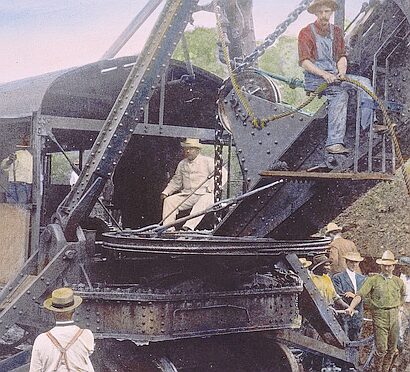
Ultimately, the Panama Canal was completed, and President Roosevelt wasted little time in taking advantage of the photo opportunities. Another president might have hesitated to embroil the U.S. in a Central American revolution, but Roosevelt had no intention of allowing a post-colonial civil war to interfere with development of the Panama Canal, which turned out to be one of history's most significant engineering projects. An estimated 25,000 members of the workforce died due to the unhealthy conditions surrounding the canal, including mosquitoes carrying malaria. Three-quarters of the original 50,000 workers brought in to build the canal were Afro Caribbean migrants from the British West Indies, such as Jamaica.
Question
What conflict in Panama threatened to limit the use of the Panama Canal?
