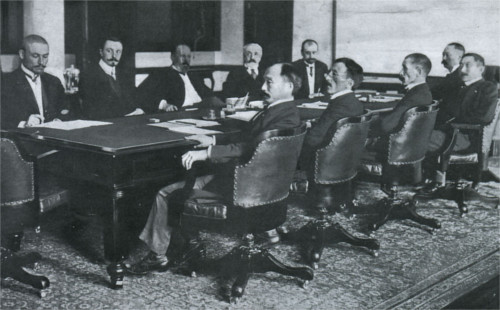
Meanwhile, international conflicts in other parts of the world also caught Roosevelt's attention. The expansion of Japanese and Russian influence into the same geographical region culminated in open naval conflict in 1904 and 1905--the Russo-Japanese War. Roosevelt interceded in the conflict and helped draft a viable resolution: the Treaty of Portsmouth, which was signed on September 5, 1905 and effectively ended hostilities between the two countries. Roosevelt later won a Nobel Peace Prize for his role in the negotiations between Russia and Japan.
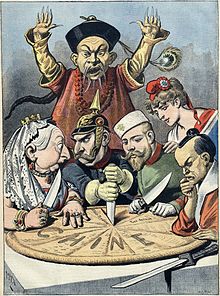
At the same time, the last vestiges of European colonialism were focused on China, as they had been throughout the latter part of the nineteenth century. The Boxer Rebellion of 1899-1901 triggered a unified show of force by Britain, Russia, Japan, France, the United States, Germany, Italy and Austro-Hungary, which acted together to quell the rebellion. A few years later, it appeared to U.S. observers that the European Powers were preparing to divide up China as they had done Africa.
Indeed, as the Colonial Age neared its conclusion, each world power seemed intent on consolidating its regional alliances and allegiances to maximize global influence. Theodore Roosevelt felt it made no sense to allow such instability to affect the Americas; in 1904, he therefore issued a "corollary" to the Monroe Doctrine. In a state of the union address, Roosevelt stated in blunt terms that the U.S. would intervene in Latin American affairs whenever and wherever Americans were threatened.
Of course, many of the world's leaders knew that the U.S. also had business interests beyond its borders, including in Central and South America. Roosevelt’s Monroe Doctrine corollary would enable U.S. military intervention whenever political instability in the Latin American region might result in dangerous conditions for U.S. government officials or U.S. businesses, including businesses located in other countries.
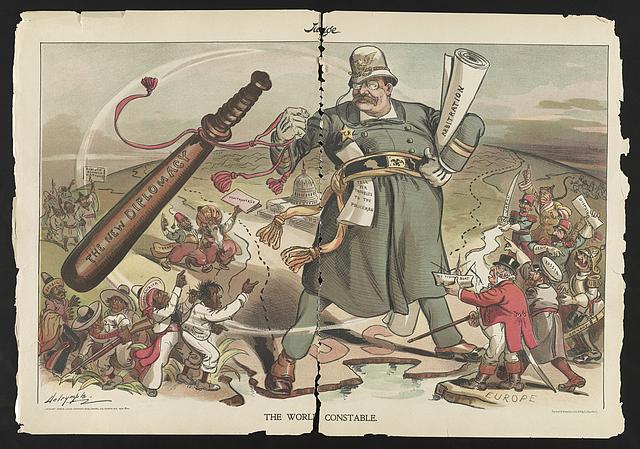
According to President Roosevelt's "big stick" approach to foreign policy, the U.S. should consider all of the potential consequences of not interfering in other nations' affairs and then take decisive action far enough in advance to prevent a crisis, once a crisis seemed likely. However, the phrase big stick probably derives from an earlier concept--"gunboat diplomacy," an idea developed during the colonial era, and a comment that Roosevelt made in 1900 as New York State Governor:
I have always been fond of the West African proverb: "Speak softly and carry a big stick; you will go far."
In essence, Roosevelt was in favor of using the threat of military intervention--or an actual military invasion--if negotiations failed and if the matter was considered important enough to involve U.S. troops. During his two terms, Roosevelt enforced the Monroe Doctrine and his corollary through multiple interventions in Latin America.
Question
Why did Roosevelt feel compelled to issue a corollary to the Monroe Doctrine?
